
SlideServe
Menu
Préférences
© SlideServe · v2026

How do you subtract fractions with unlike denominators?

matt avatar
18 diapositives · 346 Views · Jul 27, 2014

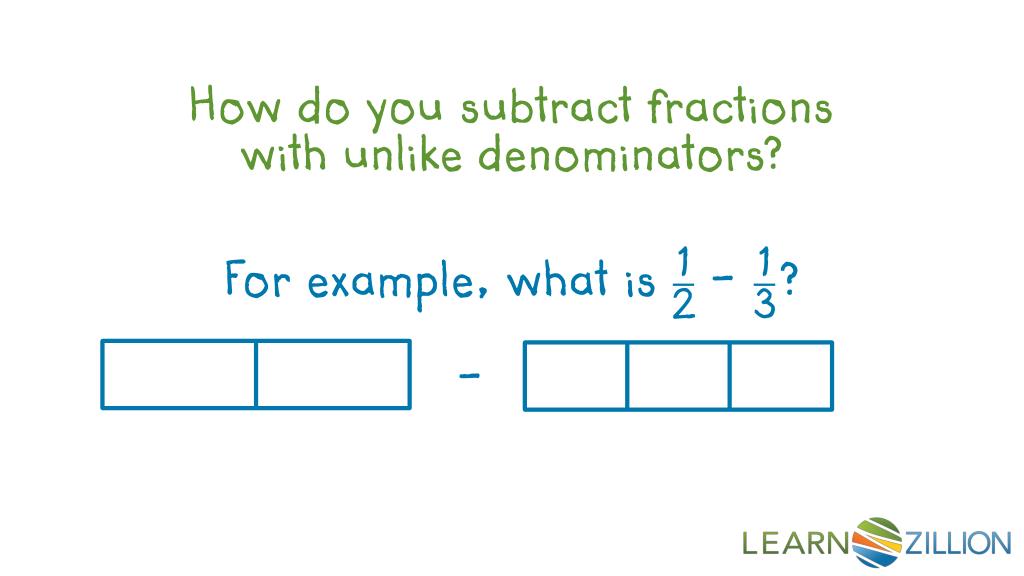
How do you subtract fractions with unlike denominators?. For example, what is - ?. -. In this lesson you will learn how to subtract fractions with unlike denominators by using fraction bars. We know that fractions need to have the same denominator to subtract them. .
How do you subtract fractions with unlike denominators? - slide 1
01 / 18How do you subtract fractions with unlike denominators?
1 / 17

Télécharger la présentation

How do you subtract fractions with unlike denominators?
Une image / un lien ci-dessous est fourni (tel quel) pour télécharger la présentation

Politique de téléchargement : le contenu du site vous est fourni TEL QUEL pour votre information et votre usage personnel ; il ne peut être vendu, concédé sous licence ni partagé sur d’autres sites sans l’accord de son auteur.Le contenu vous est fourni TEL QUEL, pour votre information et votre usage personnel uniquement. Téléchargez la présentation en cliquant sur ce lien. Lors du téléchargement, si vous ne parvenez pas à télécharger une présentation, l’éditeur a peut-être supprimé le fichier de son serveur.Pendant le téléchargement, si vous ne parvenez pas à obtenir une présentation, le fichier a peut-être été supprimé par l’éditeur.

F I N

Plus de contenu associé

Transcription de la présentation
  1. How do you subtract fractions with unlike denominators? For example, what is - ? -

  2. In this lesson you will learn how to subtract fractions with unlike denominators by using fraction bars.

  3. We know that fractions need to have the same denominator to subtract them. I can use equivalent fractions to make common denominators. I remember my teacher called this a common denominator.

  4. How do I decide which equivalent fraction to use? This could go on forever! We know that equivalent fractions show equal amounts. = = = = =

  5. When one denominator is a divisor of the other, only one fraction has to be changed. - = 2 is a divisor of 8 so I will make an equivalent fraction for . -

  6. When both denominators are multiples of 10, only one fraction has to be changed. = - I know that is equivalent to

  7. Students begin to subtract without forming a common denominator. ≠ - ≠ -

  8. What is -? - How do I decide which equivalent fractions to form? One denominator is not a divisor of the other. I can multiply any number by 1 without changing its value. Neither denominator is a multiple of 10.

  9. - Look at the denominator of the other fraction. = Multiply the pieces by 3 x Divide each part of the whole by 3 + =

  10. - Look at the denominator of the other fraction. = Multiply the pieces by 2 x Divide each part of the whole by 2 =- + =

  11. - Now I can subtract. = =- =

  12. Sammy says that - = , but Trevan says it subtracts to leave . It’s . It’s

  13. What is - ? - How do I decide which equivalent fractions to form? One denominator is not a multiple of the other. I can multiply any number by 1 without changing its value. Neither denominator is a multiple of 10.

  14. - Look at the denominator of the other fraction. = Multiply the pieces by 3 x Divide each part of the whole by 3 - =

  15. Look at the denominator of the other fraction. = Multiply the pieces by 5 x Divide each part of the whole by 5 =- - - =

  16. Now I can subtract. = - = -

  17. Trevan was correct because - = It’s . Now I see it!

  18. In this lesson you have learned how to subtract fractions with unlike denominators by using fraction bars.