Exploring Designed Experiments with Nonnormal Responses in Quality Technology
180 likes | 300 Vues
This presentation by Zhang Bingjun delves into designed experiments with nonnormal responses, showcasing two significant case studies: The Drill Experiment and The Windshield Molding Slugging Experiment. The discussion covers the application of generalized linear models (GLM) and data transformations, focusing on how these approaches can better manage nonnormal data distributions. Attention is given to the importance of confidence intervals and model assumptions, with insights from notable works in the field, enhancing our understanding of statistical methods in quality technology.


Exploring Designed Experiments with Nonnormal Responses in Quality Technology
E N D
Presentation Transcript
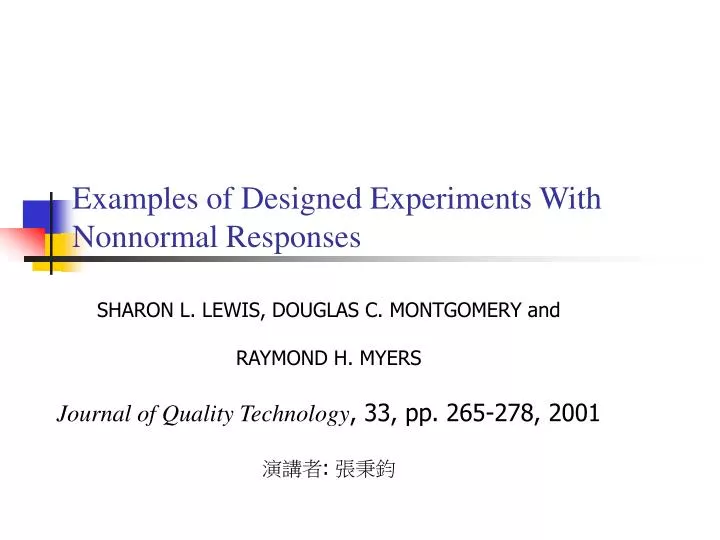
Examples of Designed Experiments With Nonnormal Responses SHARON L. LEWIS, DOUGLAS C. MONTGOMERY and RAYMOND H. MYERS Journal of Quality Technology, 33, pp. 265-278, 2001 演講者: 張秉鈞
Outline • Introduction • Example 1: The Drill Experiment • Example 2: The Windshield Molding Slugging Experiment • Conclusion
Introduction • In general, linear model : • Check model’s three basic assumption 1. Normal probability plot 2. Residuals plot • Nonnormal responses 1. data transformations 2. GLM (Generalized Linear Models)
Generalized Linear Models • Three components: (1) Response distribution is exponential family (Binomial, Poisson, Gamma, Normal, etc) (2) Linear predictor (3) Link function (relationship between the and )
More details: Introduction to Linear Regression Analysis (Chapter 13) • Software packages: SAS, S-PLUS • Objective: To compare two approaches by designed experiments with nonnormal responses • Criterion: Lengths of confidence intervals of mean response
The Drill Experiment • unreplicated factorial design • advance rate drill load flow rate rotational speed type of drilling mud used • GLM: Gamma distribution, log link function
Half -Normal Probability Plot , and are significant effects data transformation model: GLM model:
The Windshield Molding Slugging Experiment • During the stamping process, debris carried into the die appears as slugs in the product • fractional factorial design, and resolution III • number of good parts out of 1000 poly-film thickness (0.0025, 0.00175) oil mixture (1:20, 1:10) gloves (cotton, nylon) metal blanks (dry underside, oily underside)
Design Matrix and Response Data • data transformation: logistic • GLM: Binomial distribution, logistic link function
Refit the Model (GLM) • We fit the model with factors
Conclusion • Data transformations may be inappropriate for some situations • With the GLM, normality and constant variance are not required • With the GLM, length of confidence interval is short
References • HAMADA, M. and NELDER, J. A. (1997). “Generalized Linear Models for Quality-Improvement Experiments”. Journal ofQuality Technology29, pp. 292-304 • MONTGOMERY, D. C. (2001). Design and Analysis ofExperiments, 5th ed. John Wiley & Sons, Inc., New York, NY • MONTGOMERY, D. C. and PECK, E. A. (1992). Introduction to Linear Regression Analysis, 2th ed. John Wiley & Sons, Inc., New York, NY • MYERS, R. H. and MONTGOMERY, D. C. (1997). “A Tutorial on Generalized Linear Models”. Journal ofQuality Technology29, pp. 274-291