Understanding Cloud Dynamics: Precipitation and Processes in Weather Formation
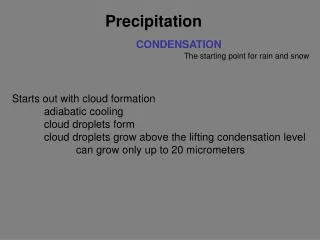
This guide explores the equilibrium of cloud droplets and the processes that lead to precipitation. It explains how condensation occurs when inbound cloud droplets exceed outbound ones, while evaporation happens when the reverse is true. Differentiating between cold and warm clouds in relation to the freezing level, we discuss collision processes, dry air effects on cloud evaporation, and coalescence, where larger droplets form from smaller ones. Finally, we categorize precipitation types, including snow, sleet, freezing rain, and standard rain at various altitudes.

Understanding Cloud Dynamics: Precipitation and Processes in Weather Formation
E N D
Presentation Transcript
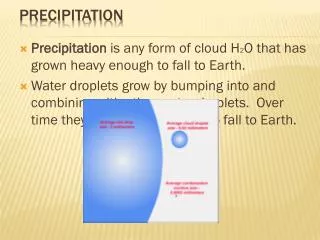
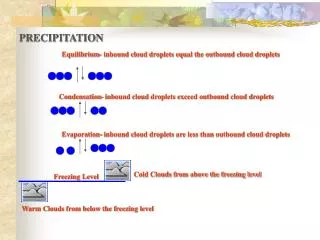
PRECIPITATION Equilibrium- inbound cloud droplets equal the outbound cloud droplets Condensation- inbound cloud droplets exceed outbound cloud droplets Evaporation- inbound cloud droplets are less than outbound cloud droplets Cold Clouds from above the freezing level Freezing Level Warm Clouds from below the freezing level
Collision Process Dry Air evaporates clouds making larger clouds Coalesence Process- Big drops absorb the little drops Ice Crystal Process -40C Ice -20C Mix 0C
Precipitation Types Snow Sleet FZ Rain Rain 3000M 1500M 0M Freezing Level