Quantum Measurement: From Quantized to Continuous Observables
Explore the fascinating nature of quantum measurement, where some quantities are quantized (like angular momentum and atomic energy levels) while others are continuous (like position and momentum of a free particle). Discover how quantum states can be prepared to give definite results for observables, either quantized or continuous, with minimal uncertainty. Learn about the probabilistic nature of measurements in quantum mechanics, superposition of states, and the representation of physical states using normalized vectors. Delve into the redundant mathematical structure in quantum mechanics and the implications of ambiguous representations of physical states.

Quantum Measurement: From Quantized to Continuous Observables
E N D
Presentation Transcript
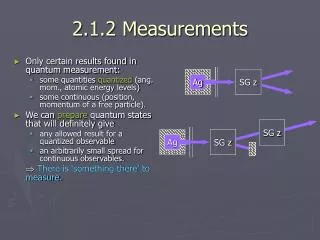
Only certain results found in quantum measurement: some quantities quantized (ang. mom., atomic energy levels) some continuous (position, momentum of a free particle). We can prepare quantum states that will definitely give any allowed result for a quantized observable an arbitrarily small spread for continuous observables. There is ‘something there’ to measure. SG z Ag SG z SG z Ag 2.1.2 Measurements
SG−z SG z SG z Measurement (continued) | SG−z SG z Ag | • If we superpose definite states of a given observable, & measure the same observable, we randomly get one of the superposed values—never an ‘intermediate’ result. • Probability of result a, Prob(a) |amplitude|2 in superposition. • We always get some result: Probs = 1.
Represent states of definite results (eigenstates) as a set of orthonormal basis vectors. Represent physical states as normalised vectors. Probability amplitude for result ai from state ψ: ci = ai |ψ. zero amplitude to get anything but ai in “definite ai” state. Use projectors instead, if degenerate. General state can always be decomposed into a superposition: Mathematical model
Represent states of definite results (eigenstates) as a set of orthonormal basis vectors. Represent physical states as normalised vectors. Probability amplitude for result ai from state ψ: ci = ai |ψ. zero amplitude to get anything but ai in “definite ai” state. Use projectors instead, if degenerate. General state can always be decomposed into a superposition: Sum of probabilities = 1 is Pythagoras rule in N-D vector space! 1 cz|z |ψ cx|x cy|y Mathematical model
2.2 Redundant Mathematical Structure • A mathematical model for a physical process may contain things that don’t have any physical meaning. • e.g. in electromagnetism, vector potential is undetermined up to a gauge change: A A + • Bad thing? May make the maths much easier! • In QM, physical states are represented by normalised vectors: • Ambiguous up to factor of eiθ, i.e. |ψ and eiθ|ψ represent the same state. • Normalised vectors do not make a vector space—maths requires vectors of all lengths. • Really, physical state equivalent to a ‘ray’ through the origin: normalisation is a convention as we could write: • Vectors of a particular length & phase needed when analysing a vector into a superposition.
Redundancy (continued) • Vector space may include unphysical vectors: • all those with infinite energy, i.e. outside the domain of the energy operator, Ĥ, (e.g. discontinuous wave functions). • Should other operators (x ? p ?) have finite expected values? • Do all possible self-adjoint operators represent physical observables? • In practice, no: we only need a few dozen. • In theory, no: some self-adjoint ops represent things disallowed by ‘superselection’ — e.g. real particles are either bosons or fermions, not some mixture.