Decision-Making Techniques in Management Accounting: A Guide to Financial Insights
This guide provides an overview of decision-making techniques in management accounting, focusing on both past and future performance. It explores the importance of financial reports, like balance sheets, and discusses the role of management accountancy in analyzing costs, risks, and values to generate strategic business insights. Key decision types—strategic, tactical, and operational—are defined, along with relevant models like decision trees and ratio analysis. Learn how to systematically evaluate options, making informed decisions to steer your organization in the right direction.

Decision-Making Techniques in Management Accounting: A Guide to Financial Insights
E N D
Presentation Transcript
Introduction to Management Accounting • Financial accountancy • Focus on past performance • Deals with financial reports e.g. balance sheet • Management accountancy • Focus on future performance • Analyses costs, risks and value to provide business insights • CIMA = world’s leading professional body for management accountants • CIMA training supports strategy formation and decision making
Types of decisions • Strategic • Big, complex, long term decisions • Usually made at senior levels • Tactical • Medium term, • Deliver the strategy • e.g. what resources or timescales needed • Operational • Day-to-day, more routine decisions taken at all levels • Involve defined resources
Management accountancy analysis skills combine with hard data Enables assessment of risk against outcomes Decision making process involves: Analysis of information Generate alternative solutions Map these to business strategy Evaluate each option’s contribution to meeting objectives Implement selected option and monitor progress How decisions are made
Decision making models • Simple decisions can be made from experience • Complex decisions need systematic approach • Decision making models provide structure, e.g. • Decision trees • Ratio analysis
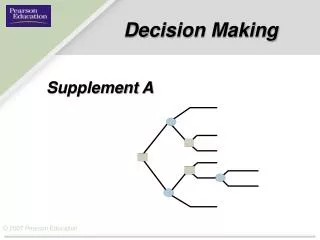
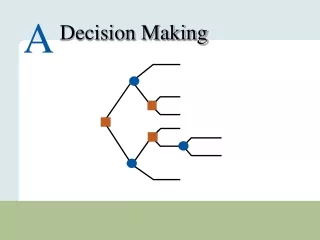
Business problems may have more than one solution Help to assess different options but need accurate data Risk of over-simplifying the problem Decision tree outlines outcomes and probabilities Decision trees
Accounting ratios compare different financial data Analysis of data highlights opportunities or threats Helps to steer business direction Ratio analysis