Enhancing Technology-Enhanced Learning: A Collaborative Research Network
120 likes | 221 Vues
The project aims to advance technology-enhanced learning through a network of 1,100 researchers and PhD students from 23 countries. With a budget of €9.35 million over four years, the initiative focuses on bridging the gap between technology and educational sciences to mitigate research fragmentation. Key aspects include the development of tools for collaborative learning, simulations, and mobile learning environments. By fostering a community of practice, sharing prototypes, and improving technology transfer, this effort seeks to enhance educational outcomes and promote innovative research methodologies.


Enhancing Technology-Enhanced Learning: A Collaborative Research Network
E N D
Presentation Transcript
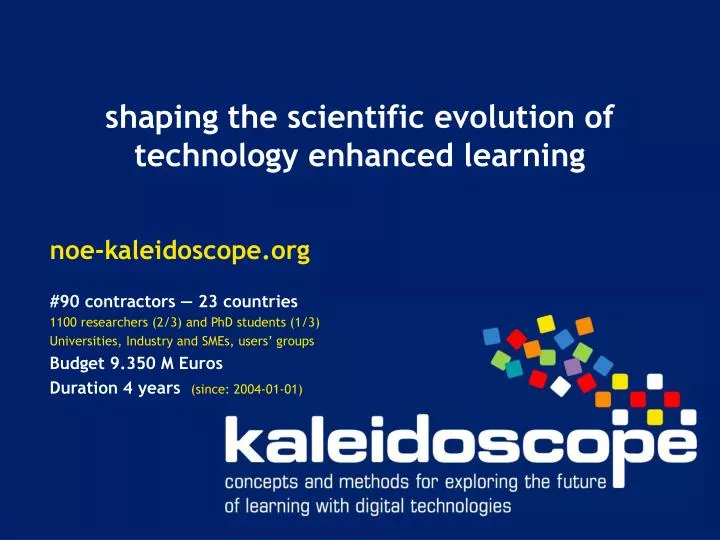
shaping the scientific evolution of technology enhanced learning noe-kaleidoscope.org #90 contractors — 23 countries 1100 researchers (2/3) and PhD students (1/3) Universities, Industry and SMEs, users’ groups Budget 9.350 M Euros Duration 4 years (since: 2004-01-01)
Need for convergence to fight research fragmentation • Network • Learning community (CSCL) • Learning space (Grid) • Content • Simulation, augmented reality • Semantically rich representation • Ubiquity and mobility • Interaction • Reification of interactions • Digital imprint of tacit knowledge
An integrated vision Berlin symposium November 2006 • Document • Simulations • Microworld • Knowledge • Ability Technology inquiry learning Learner • Interactive • Wireless • Distributed • Ubiquitous • Trustable collaborative learning mobile learning • Autonomous • Socialized • Collaborative Situations • School • Informal learning • Learning at work • Training
Scientific and strategic integration • To build bridges between technology, computer science and, educational, social and cognitive sciences in order… • To provide better foundations to the evaluation of TEL • To stimulate the sharing of prototypes and testbed • To improve technology transfer and innovation • To develop a shared understanding of the differences and commonalities at a conceptual and methodological level… • across disciplines • across cultures • research practices • To build bridges between the different educational traditions
and a structure to leverage integration A stronger community to significantly develop SIG : Special Interest Groups ERT : European Research Teams Open ArXiv Open Source Open Access VDS : Virtual doctoral school Gateway Users’ Group Academy/Industry
A VDS providing PhD students with useful resources • Production of specific information: • Information / post-graduate programs • Research Methods bibliography (dynamic) • Different resources: • Kaleidoscope documents • Outputs from learning activities • TeLearn open archive(documents and video) • Community of interest • Virtual study groups • Access to experts and advisors
www.telearn.org Yesterday 467 articles 81 videos
Standardizeddescription, stamps, shared concerns 1 1 2 2 3 3 www.telearn.org Publications
Benefits and issues for PhD students • To enhance the young researchers training • Need for different kind of research training: • generic, advanced and specialized • elearning related • Short courses (on demand), support to paper writing • Easy access to resources, academic papers • To develop a shared understanding • Desire to contact other PhD students in similar areas • Access to academics and projects from other countries • To handle the diversity • Different views of what is research in the field • Heavy language barriers to internationalization