Understanding Aquatic Energy Sources and Water Chemistry
This study guide covers key concepts related to aquatic ecosystems, focusing on energy sources such as thermal and chemical from hydrothermal vents, human-induced thermal energy inputs from power plants, and the role of different organisms. It elaborates on the importance of organic and inorganic materials in water chemistry, species richness, microbial roles, and bioremediation processes. You'll also discover the impact of toxins and chemicals on aquatic life, as well as significant cycles like the nitrogen cycle. Essential terms and concepts are highlighted to aid understanding.

Understanding Aquatic Energy Sources and Water Chemistry
E N D
Presentation Transcript
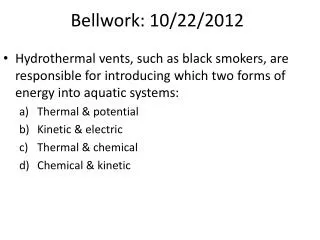
Bellwork: 10/22/2012 • Hydrothermal vents, such as black smokers, are responsible for introducing which two forms of energy into aquatic systems: • Thermal & potential • Kinetic & electric • Thermal & chemical • Chemical & kinetic
Bellwork: 10/22/2012 • Which of the following is the largest source of thermal energy put into aquatic systems by humans: • Water run-off from agricultural land • Water run-off from residential streets that collect oil • Plastics introduced during the chemical processing at energy plants • Power plants using local bodies of water to cool off their equipment
Exam Review • Organic vs. Inorganic • Organic contains carbon • Percentage of Freshwater • 2.5% of the planet’s water is fresh water • Common elements in organic molecules • Alkalinity • The ability of a solution (body of water) to buffer against a change in pH, specifically an increase in acidity
Exam Review • Carbonate system Carbonic Acid Carbonate CO2(g) Bicarbonate CO2(aq) H2CO3 HCO3– CO32- H+ H+ H2O Ca2+ CaCO3(s)limestone
Exam Review • Diatoms – • Most common brown algae • Euglena – • Has both animal & plant features, protist, prominent flagella • Paramecium – • Protist covered in cilia • Hydra – • Animal with a tremendous regenerative ability • Amoeba – • Protist that uses phagocytosis to consume other organisms
Exam Review • Microbes & biomass • Microbes account for ~ 50% of all biomass on Earth • They are ubiquitous on the surface and deep within the earth • Species richness • the total number of different species present • Species abundance • the proportion of each species in an ecosystem
Exam Review • Guilds • Metabolically related microbial populations • Microbial species richness and abundance is a function of the kinds and amounts of nutrients available in a given habitat • Niche • Job/role an organism plays within its environment • Prime Niche • For each organism there exists at least one niche in which that organism is most successful
Exam Review • Biofilms • Assemblages of bacterial cells adhered to a surface and enclosed in an adhesive matrix excreted by the cells • The matrix is typically a mixture of polysaccharides • Formation & purpose of biofilms • Self-defense • Biofilms resist physical forces that sweep away unattached cells, phagocytosis by immune system cells, and penetration of toxins (e.g., antibiotics) • Allows cells to remain in a favorable niche • Allows bacterial cells to live in close association with one another
Exam Review • Biochemical Oxygen Demand (BOD) • The microbial oxygen-consuming capacity of a body of water • Prochlorophytes • > 40% of the biomass of marine phototrophs • ~50% of the net primary production • Most of the primary productivity in the open oceans
Exam Review • Psychrophilic • cold-loving • Barophilic • pressure-loving
Exam Review • Change in ratios of archaea/bacteria through aquatic life zones
Exam Review • Hydrothermal vent microbes • Chemolithotrophic prokaryotes that utilize reduced inorganic materials emitting from the vents form endosymbiotic relationships with vent invertebrates such as vent tube worms • Chemolithotrophic • Organisms that use inorganic matter (chemicals) to create their own food (chemo-auto-trophs)
Exam Review Simplified Nitrogen Cycle Nitrogen Fixation Nitrosofying Bacteria Nitrifying Bacteria Denitrifying Bacteria NH4+ Ammonium NO2– Nitrite N2 Nitrogen NO3– Nitrate Nitrification Denitrification Aerobic Anaerobic
Exam Review • Bioremediation • Refers to the cleanup of oil, toxic chemicals, or other pollutants from the environment by microorganisms • Often a cost-effective and practical method for pollutant cleanup • Xenobiotics – • chemically synthesized compounds that have never occurred in nature (pesticides, herbicides, plastics). • Phytoremediation: • Degrading a pollutant using sunlight/UV light • Downsides: only the surface is effected, and its slow
Exam Review • Chemical Cocktails – • A mixture of chemicals that, when consumed independently cause no/little harm, but when put together can have damaging, and rarely studied effects.
Exam Review • Oxygen depleting contaminants • organic carbon + O2 + bacteria → CO2 + H2O + more bacteria • if oxygen is depleted in natural water, most aquatic life will die (Ex. fish kills) • C:N:P molar ratio ideal for bacterial growth • 100:10:1 • Phosphorous is often the limiting factor in bacterial/algal growth
Exam Review • Cyanotoxins - • Produced by algal blooms (blue-green algae) that is toxic to humans and most animals. Under the right conditions, these blooms can reduce DO to the point that nearby organisms will asphyxiate. • Effects of Total Dissolved Salts • Measured as Total Dissolved Solids (TDS) • High salt concentration can damage crops, reduce soil’s permeability • In drinking water, recommended thatTDS < 500 mg/L
Exam Review • Thermal pollution • Primarily cooling water from power plants and other industries • ↑Temperature, ↓Dissolved oxygen • ↑Temperature, ↑bacterial growth, ↓O2
Exam Review • Sources of Nitrates in water • Septic systems (on-site waste water disposal systems) • Runoff and leaching from agricultural land, residential lawns and gardens (nitrogenous fertilizers) • Animal wastes (ranging from confined animal feeding operations to horses in the pasture) • Methemoglobinemia • In humans, nitrate (NO3-) is reduced to nitrite (NO2-) • Nitrite binds with hemoglobin to form methemoglobin, a substance that cannot bind and transport oxygen • Methemoglobinemia effects
Exam Review • Chlorine byproducts (DBPs) • Chlorine is a common disinfectant in drinking water • Excellent oxidizing disinfectant • Inactivates most bacteria, viruses and certain protozoa • Most DBPs are regulated based on their suspected human carcinogenicity (known carcinogenicity to laboratory animals) • Epidemiologic evidence that chlorine DBPs, primarily trihalomethanes, are related to adverse reproductive outcomes
Exam Review • Trihalomethanes– • The most common DBP, highly volatile • Viruses – • Smallest known microbial contaminant • Consist of a DNA/RNA filled capsid & enzymes • Bacteria – • Simple internal organization, simple life cycle, flagellated • Creates spores when stressed
Exam Review • Protozoa – • Complex, single-celled organisms • Complex life cycle • Forms cysts/oocysts when stressed • Helminths – • Parasitic worms ranging in size from microscopic to over one meter in length • Very complex life cycles • Eggs serve as the environmentally resistant form for helminths
Exam Review • E. coli – • bacteria • Small number of US outbreaks & low number of cases. 3 to 5% fatal • Fomite – • An inanimate object that houses pathogens • Salmonella – • Bacteria • 12 to 30% mortality, low # of outbreaks, slightly higher # of cases
Exam Review • Vibrio cholera – • Bacteria • Low rate of infection within the US, but responsible for a many-decade pandemic in Asia, Africa, and Latin America • Giardia – • Protist • Larger number of US outbreaks higher rate of infection than common infectious bacteria
Exam Review • Cryptosporidium– • Protist • Small number of US outbreaks yielding an extremely high rate of infection (421,473 cases) • 1-3% US, 5% Asia, 10% Africa infected at any given time • Toxoplasmosis – • Oocysts are extremely resistant to common disinfectants • Cats are the definitive host for Toxo • Close to 25% of US population is infected • Life threatening to immuno-compromised individuals • Congenital infected children
Exam Review • Platyhelminthes – • “flat” worms • Common examples: tape worms, flukes • Ashelminthes – • “round” worms • Hookworms, ascaris, trichinella, etc • Lung Fluke – • Hookworms – • Extensive lifecycle: burrowing into skin, travelling through blood, lungs, stomach, then small intestine • Shed 10,000 to 20,000 eggs per day • Can consume 0.2mL of blood per adult per day
Exam Review • Trichinella– • “Biblical worm” • Most commonly found in swine muscle tissue & our first example of nature/parasites/illnesses changing/shaping human culture • Causes painful & aching muscles in infected humans • Ascaris– • Large (25-45 cm) & most common infectious worm • Common where sanitation is poor & human feces is used as fertilizer
Exam Review • How does mercury turn into a more toxin form once it makes its way into a water source? • Bacteria consumes & metabolizes mercury and the heavy metal is changed into methyl-mercury (a more biologically toxic form of mercury) • What is a natural way to remove nitrogen runoff prior to it reaching open water? • Increase the amount of trees & other photosynthetic organisms in between sources of runoff & bodies of water
Exam Review • What are some effects of chlorine byproducts on the reproductive health of men & women? • Men – decreased sperm count & sperm health • Women – increase in the rate of miscarriages, birth defects & incidents of failure to thrive in infants.
Hydrothermal vents, such as black smokers, are responsible for introducing which two forms of energy into aquatic systems: • Thermal & potential • Kinetic & electric • Thermal & chemical • Chemical & kinetic
Which of the following is the largest source of thermal energy put into aquatic systems by humans: • Water run-off from agricultural land • Water run-off from residential streets that collect oil • Plastics introduced during the chemical processing at energy plants • Power plants using local bodies of water to cool off their equipment