Understanding Proteins: Chemistry, Structure, and Metabolism
480 likes | 597 Vues
This chapter explores the intricate world of proteins through a chemist's lens, detailing their composition of amino acids, structures, and key functions in the body. It covers the characteristics of amino acids, including essential and nonessential types, and the significance of peptide bonds. Delving into the digestive process, protein absorption and synthesis, it highlights the unique roles proteins play as enzymes, hormones, and structural materials within cells. The chapter further examines protein metabolism, nitrogen balance, and the importance of dietary influences on gene expression and overall health.


Understanding Proteins: Chemistry, Structure, and Metabolism
E N D
Presentation Transcript
Protein: Amino Acids Chapter 6
The Chemist’s View of Proteins • Atoms • Carbon, hydrogen, oxygen, nitrogen • Amino acids • Carbon • Hydrogen • Amino group • Acid group • Side group or side chain
The Chemist’s View of Proteins • More complex than carbohydrates or fats • Twenty amino acids (AA) • Different characteristics • Essential amino acids • Nonessential amino acids • Conditionally essential
The Chemist’s View of Proteins • Proteins • Peptide bonds link amino acids • Condensation reactions • Amino acid sequencing • Primary structure – chemical bonds • Secondary structure – electrical attractions • Tertiary structure – hydrophilic & hydrophobic • Quaternary structure – two or more polypeptides
The Chemist’s View of Proteins • Protein • Denaturation • Disruption of stability • Uncoil and lose shape • Stomach acid
Protein Digestion • Protein in food ≠ muscle in body • Must be broken down and built back up Protein (long polypeptides) Short polypeptides Tripeptides and dipeptides Amino acids
Protein Digestion • Mouth • Mostly mechanical • Stomach • Hydrochloric acid denatures proteins • Pepsinogen to pepsin • Small intestine • Hydrolysis reactions • Peptidase enzymes
Protein Digestion in the GI Tract Know these by name and function Be able to recognize these names, don’t need to know exact mechanism of action
Protein Absorption • Specific carriers transport into intestinal cells • Some amino acids used by intestinal cells • Unused amino acids transported to liver • Through bloodstream to liver • Reminder: enzymes are digested when they are inactive – different pH levels are optimal • Myth: predigested proteins are easier for the body to handle (i.e. better for you)
Protein Synthesis • Uniqueness of each person determined by differences in proteins • Uniqueness found in amino acid sequences • Determined by genes – DNA • Diet is key to protein synthesis • Adequate protein • Essential amino acids
Protein Synthesis • DNA transcription RNA translation protein • 2 Steps: • Transcription: DNA template makes mRNA • mRNA carries code across nuclear membrane to attach to ribosome • Ribosomes are protein factories • Translation: mRNA specifies AA sequence • tRNA carry AA to ribosomes
Protein Synthesis • Gene expression and protein synthesis • Cells differentiate based on protein needs • Pancreas – insulin • RBC – hemoglobin • Dietary influence on gene expression • Protein and amino acids available to body • Disease development
Roles of Proteins • Structural materials • Building blocks for most body structures • Collagen: teeth, ligaments/tendons, arteries • Replacement of dead or damaged cells • Enzymes • Break down (digestion), build up (bone), and transform substances (gluconeogenesis) • Catalysts: remain unchanged, reusable
Roles of Proteins • Hormones • Messenger molecules • Transported in blood to target tissues • Regulators of fluid balance • Edema • Acid-base regulators • Attract hydrogen ions • Transporters – specificity
Roles of Proteins • Antibodies • Defend body against disease • Specificity • Immunity – memory • Energy and glucose • Starvation or insufficient carbohydrate intake • Other roles • Vision, blood clotting
Preview of Protein Metabolism • Protein turnover & amino acid pool • Constant production/destruction in each cell • Amino acid pool pattern is fairly constant • Used for protein production • Used for energy – if stripped of nitrogen • Nitrogen balance • Zero nitrogen balance • Positive and negative nitrogen balance
Preview of Protein Metabolism • Making other compounds (not just protein) • Neurotransmitters • Melanin • Thyroxin • Niacin • Energy and glucose • Wasting of lean body tissue • Adequate intake of carbohydrates and fats
Preview of Protein Metabolism • Making fat • Energy and protein exceed needs • Carbohydrate intake is adequate • Can contribute to weight gain • Deaminating amino acids • Stripped of amino group (N-containing) • Ammonia • Keto acid
Preview of Protein Metabolism • Make proteins & nonessential amino acids • Essential: breakdown of proteins • Nonessential: keto-acids • Liver makes nonessential • Converting ammonia to urea • Liver – ammonia and carbon dioxide • Dietary protein ammonia production
Preview of Protein Metabolism • Excreting urea • Liver releases urea into blood • Kidneys filter urea out of blood • Liver disease ( blood ammonia) • Kidney disease ( blood urea) • Protein intake and urea production • Water consumption
Proteins in Food: Protein Quality • Two factors • Digestibility • Animal proteins (>90%) • Plant proteins (70-90%; soy, legumes >90%) • Amino acid composition • Essential amino acid consumption • Nitrogen-containing amino groups • Limiting amino acid
Protein Quality • Reference protein • Preschool-age children • High-quality proteins • Animal proteins • Plant proteins • Complementary proteins • Low-quality proteins combined to provide adequate levels of essential amino acids
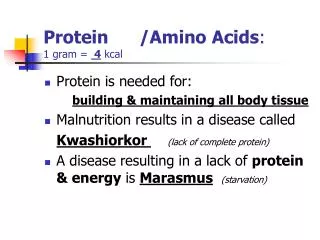
Health Effects of Protein • Protein deficiency • Consequences • Protein-energy malnutrition • Marasmus and kwashiorkor • Heart disease • Animal-protein intake • Homocysteine levels • Arginine levels
Health Effects of Protein • Cancer • Protein-rich foods; not protein content of diet • Osteoporosis • Increase in calcium excretion • Animal proteins • Weight control • Kidney disease • Acceleration of kidney deterioration
Recommended Intakes of Protein • Need for dietary protein • Source of essential amino acids • Practical source of nitrogen • AMDR: 10-35% of daily kcalorie • RDA: adults = 0.8g / kg of body weight • Groups with higher recommended intakes • Assumptions • Adequate energy
From Guidelines to Groceries • Protein foods • One ounce equals 7 grams of protein • USDA Food Patterns • Recommended sources • Milk and milk products • Fruits, vegetables, and grains • Read food labels • Current US and Canada intakes • Moderation
Protein and Amino Acid Supplements • Protein powders • Muscle work vs. protein supplements • Whey protein • Amino acid supplements • Potential risks associated with intake • Branched-chain amino acids (BCAA) • Lysine & tryptophan