Download
1 / 13
130 likes | 233 Vues
Assessment of climate change impacts on biome stability in Namakwa District, highlighting areas crucial for ecosystem resilience. The study uses revised climate data and models to predict future scenarios and identify areas at risk. Methods include MAXENT modeling for accurate prediction of biome changes.

E N D
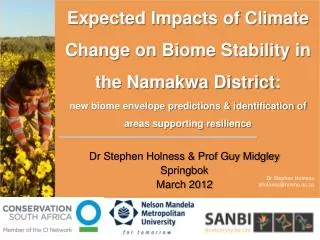
Expected Impacts of Climate Change on Biome Stability in the Namakwa District:new biome envelope predictions & identification of areas supporting resilience Dr Stephen Holness & Prof Guy Midgley Springbok March 2012
Components • “Areas of biome stability” • Particular parts of the Namakwa District are at higher risk from climate change induced impacts • “Areas important for supporting ecosystem resilience to climate change impacts” • Intact ecosystems have the potential to reduce climate change impacts through supporting ecosystem based adaptation • Particular parts of the district are of particularly high value for supporting cc resilience
Technical process (1) • Revised climate data from 15 GCMs were used to calculate anomalies between now and mid century • Does not focus on a single model • Used the range of predicted outcomes from these models to define three scenarios: • High risk scenarios with low rainfall and high temperatures • a medium risk scenario • and low risk scenario with high rainfall and smallest temperature • Anomaly calculated and combined with current agro hydrology data
Technical Process (2) • MAXENT - widely used ecological modelling and forecasting program (we will now extend this to other methods) • Model of current biomes & test prediction ability • Develop biome maps for future high, medium and low risk scenarios • Identify areas with high risk of biome envelope change and areas which are likely to remain stable.
Can we predict biomes? “Actual current” “Modelled current” • MAXENT models of each biome • Biome determined by strongest model outputs at each site • 86% accurate prediction – most missed blocks have a mixture or are on boundaries
Current Biomes Current Biomes