Understanding Quadrilaterals: Properties and Classifications
This chapter delves into the classification of quadrilaterals, including parallelograms, rhombuses, rectangles, squares, kites, and trapezoids. Key properties of parallelograms are outlined, such as congruent opposite sides and angles, and the conditions required to prove that a quadrilateral is a parallelogram. It highlights special properties of rhombuses, rectangles, and trapezoids, including their unique angle and diagonal characteristics. Additionally, the chapter includes proofs using coordinate geometry, helping to visualize these shapes in the coordinate plane.

Understanding Quadrilaterals: Properties and Classifications
E N D
Presentation Transcript
Geometry Chapter 6 By: Cate Hogan, Austin Underwood, Paige Mager
Classifying Quadrilaterals • Parallelogram: A quadrilateral with both pairs of opposite sides being parallel • Rhombus: A parallelogram with four congruent sides • Rectangle: parallelogram with four right angles • Square: parallelogram with four congruent sides and four right angles • Kite: a quadrilateral with two pairs of adjacent sides congruent and no opposite sides congruent • Trapezoid: a quadrilateral with exactly one pair of opposite sides
Properties of Parallelograms • Opposite sides of a parallelogram are congruent • Opposite sides are congruent • Opposite angles are congruent • Consecutive angles are supplementary • Diagonals bisect each other • Diagonals form two congruent triangles
Proving That a Quadrilateral is a Parallelogram • If both pairs of opposite sides of a quadrilateral are congruent, it is a parallelogram • If both pairs of opposite angles of a quadrilateral are congruent, it is a parallelogram • If the diagonals of a quadrilateral bisect each other, it is a parallelogram • If one pair of opposite sides of a quadrilateral is both congruent and parallel, then it is a parallelogram
Special Parallelograms • Rhombus: • If one diagonal bisects two angles of a parallelogram, then the parallelogram is a rhombus • If the diagonals of a parallelogram are perpendicular, then the parallelogram is a rhombus • Rectangle: • If the diagonals of a parallelogram are congruent, then the parallelogram is a rectangle • Square: • Combine properties previously mentioned in the slide
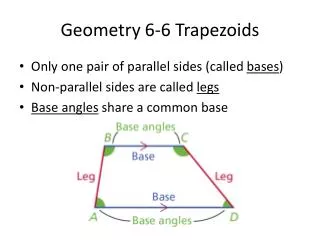
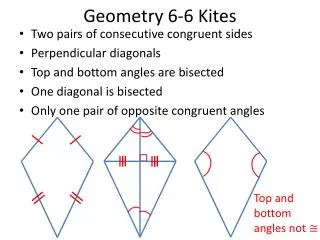
Trapezoids and Kites • Trapezoid: • Base sides are parallel • The two pairs of angles between the bases are supplementary • Isosceles trapezoid: • Look at properties of a trapezoid • Base angles are congruent • Diagonals are congruent • Kite: • Diagonals are perpendicular • Side angles are congruent • Vertical diagonals form two congruent triangles • Diagonals bisect top and bottom angles
Placing figures in the Coordinate Plane • Consecutive points should be connected segments of the shape
Proofs Using Coordinate Geometry • The midsegment of a trapezoid is parallel to the bases • The length of a midsegment of a trapezoid is (b1+b2) 2
Citations • Prentice Hall Mathematics Geometry Textbook • http://www.google.com/imgres?um=1&safe=active&hl=en&noj=1&biw=1024&bih=585&tbm=isch&tbnid=tVKakCfduEexWM%3A&imgrefurl=http%3A%2F%2Fwww.sparknotes.com%2Ftestprep%2Fbooks%2Fnewsat%2Fchapter20section5.rhtml&docid=XBt3YIVvH7ywqM&imgurl=http%3A%2F%2Fimg.sparknotes.com%2Fcontent%2Ftestprep%2Fbookimgs%2Fnewsat%2F0008%2Ftrapezoid.gif&w=150&h=83&ei=-jXZUsHgIcvOkQer7YGYCw&zoom=1&iact=rc&dur=47&page=1&start=0&ndsp=14&ved=0CF4QrQMwAg • http://www.google.com/imgres?um=1&safe=active&sa=X&hl=en&noj=1&biw=1024&bih=585&tbm=isch&tbnid=FYqSO0UhFpTVBM%3A&imgrefurl=http%3A%2F%2Fshare.ehs.uen.org%2Ftaxonomy%2Fterm%2F237%3Fpage%3D6&docid=s4Hy89s-aY3ywM&imgurl=https%3A%2F%2Fshare.ehs.uen.org%2Fsites%2Fdefault%2Ffiles%2Fimages%2Funit4l2congruent.png&w=191&h=139&ei=bDXZUpW_JpOekAff24CgBQ&zoom=1&iact=rc&dur=4063&page=1&start=0&ndsp=15&ved=0CGcQrQMwBQ • http://www.google.com/imgres?um=1&safe=active&hl=en&biw=1024&bih=585&tbm=isch&tbnid=_iQEMm14LPy6kM%3A&imgrefurl=https%3A%2F%2Fshare.ehs.uen.org%2Fnode%2F14948&docid=OIDrJxasIiXmLM&imgurl=https%3A%2F%2Fshare.ehs.uen.org%2Fsites%2Fdefault%2Ffiles%2Fimages%2Fsquare_0.png&w=147&h=150&ei=0zTZUsiZDs_NkQee8YHADg&zoom=1&iact=rc&dur=3735&page=1&start=0&ndsp=14&ved=0CFYQrQMwAA • http://www.google.com/imgres?um=1&safe=active&hl=en&biw=1024&bih=585&tbm=isch&tbnid=H18yE9rqJTrTnM%3A&imgrefurl=http%3A%2F%2Fen.wikipedia.org%2Fwiki%2FRectangle&docid=BbQmzrq9QCfY4M&imgurl=http%3A%2F%2Fupload.wikimedia.org%2Fwikipedia%2Fcommons%2Fthumb%2F3%2F38%2FRect_Geometry.png%2F220px-Rect_Geometry.png&w=220&h=143&ei=KDTZUri8IYX6kQeUlIGYDQ&zoom=1&iact=rc&dur=3797&page=2&start=10&ndsp=13&ved=0CHoQrQMwDA • http://www.google.com/imgres?um=1&safe=active&sa=N&biw=1024&bih=585&hl=en&tbm=isch&tbnid=Iz_KqUvFofUCpM%3A&imgrefurl=http%3A%2F%2Fmrbgeometry.wordpress.com%2Fquadrilaterals%2Fspecial-quadrilaterals%2F&docid=C0IMKv9_xxs-DM&imgurl=https%3A%2F%2Fmrbgeometry.files.wordpress.com%2F2012%2F03%2Frhombus-mar-24-2012-10-33-am.jpg&w=883&h=701&ei=gjPZUrGWGIO0kQf9vYC4BA&zoom=1&iact=rc&dur=1250&page=1&start=0&ndsp=13&ved=0CG0QrQMwBw • http://www.google.com/imgres?um=1&safe=active&hl=en&biw=1024&bih=585&tbm=isch&tbnid=as3uIIWQqkmqNM%3A&imgrefurl=http%3A%2F%2Fwww.wyzant.com%2Fresources%2Flessons%2Fmath%2Fgeometry%2Fquadrilaterals%2Fproperties_of_parallelograms&docid=UoWo3FOBI5iLQM&imgurl=http%3A%2F%2Fwww.wyzant.com%2FImages%2FHelp%2Fparallelogram1.gif&w=317&h=191&ei=UDrZUoDqLMjvkQeXloGICA&zoom=1&iact=rc&dur=203&page=1&start=0&ndsp=11&ved=0CF8QrQMwAw