Exploring the Pantheon: History, Design, and Architectural Marvels
This presentation delves into the Pantheon in Rome, one of the best-preserved monuments from the Greco-Roman era. It features detailed insights into its history, including the inscription honoring Marcus Agrippa, its transformation from a temple to a Christian church, and its continued use since the 7th century. The stunning dome, an engineering feat of its time, remains the largest unreinforced concrete dome to date. The presentation covers various architectural elements, including the ingenious design of the dome and the structure's enduring significance.

Exploring the Pantheon: History, Design, and Architectural Marvels
E N D
Presentation Transcript
The Pantheon PowerPoint: beyond the basicsHyperlink exercise Adam Warrena.j.warren@soton.ac.uk023 8059 4486 University of SouthamptonCentre for Learning and Teaching
Table of Contents • The Pantheon in Rome • the inscription on the pediment • the interior • the dome • detail • Pantheon – history and design
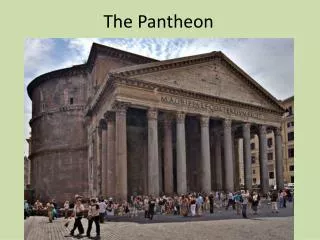
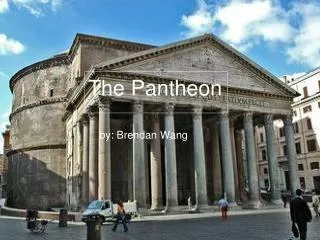
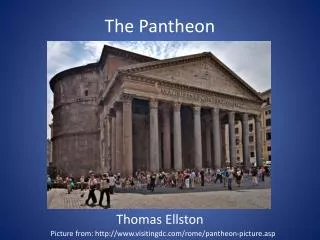
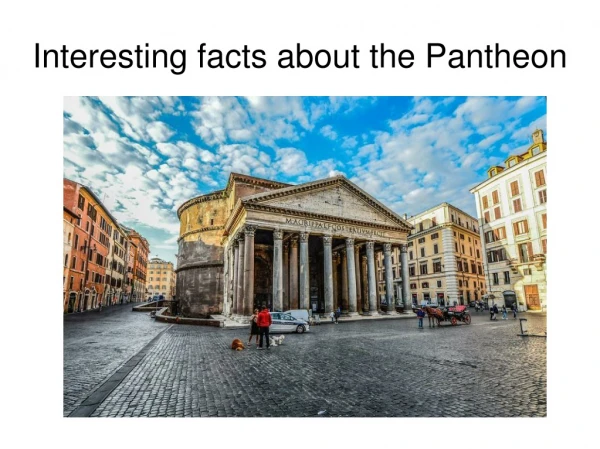
Pantheon inscription The inscription reads M.AGRIPPA.L.F.COS.TERTIUM.FECIT, meaning "Marcus Agrippa, son of Lucius, Consul for the third time, built this." In fact, Agrippa's Pantheon was destroyed by fire in 80 AD, and the Pantheon was completely rebuilt in about 125 AD, during the reign of the Emperor Hadrian, as date-stamps on the bricks reveal. Presumably some or all of the facade, including the inscription, survived from the old Pantheon.
Pantheon interior The Pantheon is a building in Rome which was originally built as a temple to all the gods of the Roman state religion, but has been a Christian church since the 7th century AD. It is the only building from the Greco-Roman world which is completely intact and which has been in continuous use throughout its history.
Pantheon dome Once the Romans learned to use concrete, they were able to mould on the ground their rounded tops for their buildings and hoist them into place on top of a rotunda. The Pantheon is just such a structure with an opening at the centre top of the dome. Because this opening is not covered, the floor is slightly concave with a drain at the centre so as to catch the rain when necessary. The dome has a span of 43.2 m, the largest dome in the world until Brunelleschi's dome at the Florence Cathedral of 1420-36.
Pantheon dome (detail) Note the advanced construction technique – this shape minimises the weight of the dome while retaining the ribs needed for structural strength.