World War I and the Aftermath
210 likes | 332 Vues
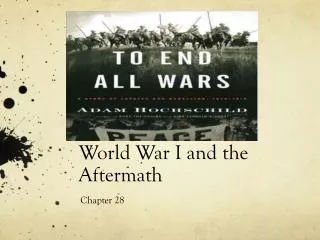
Chapter 28 explores the complex interplay of old military tactics and modern advancements that led to unprecedented casualties in World War I, the first modernized conflict where airplanes, machine guns, tanks, and chemical warfare dominated the battlefield. It examines the roots of this global warfare in imperialism and extensive alliances, the nationalistic fervor of the time, and the pivotal events leading to the war, including the assassination of Archduke Ferdinand. The chapter also addresses the war's aftermath, including the harsh Treaty of Versailles, colonial struggles for independence, and the rise of nationalist movements across different regions.


World War I and the Aftermath
E N D
Presentation Transcript
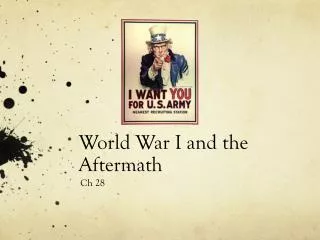
World War I and the Aftermath Chapter 28
I. Introduction • 1st modernized war • Old tactics met new technology producing mass slaughter! • 1st war in which airplane was used • Other new technology: machine gun, tank, chemical warfare, submarine • Global warfare • Result of imperialism • Extensive alliances (MANIA) • Triple Entente- Britain, France and Russia • Central Powers- Germany, Austria-Hungary and Ottoman Empire
II. The War and Before • Imperialism led to conflict over territory • Arms build ups with extensive mobilization plans • Jingoism- extreme militaristic nationalism • Balkans were consistently a problem • Diverse, Slavic region • Serbia was free of Ottoman control and resistant to Austria-Hungary’s control • Archduke Ferdinand and his Wife went on a trip to Serbia • GavrielPrincip assassinated both of them
II. The War and Before • Balkans (continued) • Austria-Hungary sought to punish Serbia • Russia vowed to back up their fellow Slavs • Brings in all of the Alliances • The War Plan • Germany had a 2 front war • Schlieffen Plan- Quickly overwhelm France and Britain and move on to Russia while they are still trying to mobilize • Didn’t work- led to a stalemate
II. The War and Before • Warfare • Millions died with little or no progress • Entente- Dead 5,712,379 Wounded 12,809,280 • Central – Dead 4,010,241 Wounded 8,419,533 • New Weapons caused high casualties- Old War Tactics • Diseases caused high casualties • Gallipoli • Tried to open supply route to Russia • Gain control of Constantinople • Ironically, a major advocate of plan was Winston Churchill, who at the time was Lord of the Admiralty
II. The War and Before • Russia • High number of casualties • Aristocratic officers • Poorly trained peasants • Lack of coding in communications • Nicholas II tried to take control of army • He gets blamed • Had to bail on Entente due to uprisings at home • Treaty of Brest-Litovsk 1918
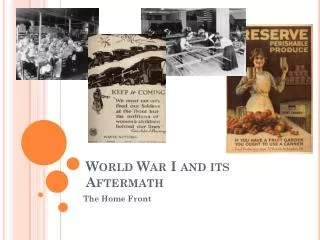
II. The War and Before • Home-fronts • Government takes over key industries • Shortages of food and fuel • Rationing • Women in the workforce • Women had to do the job of men • Suffrage in US • Extreme Nationalism • Propaganda • Citizens were very zealous
II. The War and Before • Colonies • Fought on the side of their colonial rulers • Supplied large amounts of raw materials • Japan • Allied with Britain to expel Germany from Shangdong Peninsula • Became an imperial power themselves • East Africa and Ottoman Empire sided with Germans • Ottoman Empire fell apart as a result
II. The War and Before • United States • Joins in 1917 • Helped break the stalemate • Brought into the war after Zimmerman Telegram (other stepping stones, German sub sinks the Lusitania) • The End • Freed from the Eastern Front, German made a huge advance • Turning point- 2nd Battle of the Marne • Tanks • Spanish Flu • German Surrender (shocked German people, their land was not invaded, occupied, destroyed like France) • Armistice Day- Nov 11, 1919 • Versailles Conference 1919- Germany had no representation
III. The Aftermath • France (Clemenceau) wanted to punish Germany • Take away territory and pay reparations • Wilson- Wanted peace and self-determination for people who wanted freedom • Wanted League of Nations • Did not want to punish Germany • League of Nations
III. The Aftermath • Peace of Paris • Germany had no say- Representatives forced • German territory broken up • Forced to pay reparations- collapsed economy • Austria-Hungary split up • Ignored Arab nations and promises to them • Actually divided their lands rather than help them • League of Nations • Ignored Japan and its encroachment of Chinese territory • US vetoed League of Nations and made separate treaty with Germany- Even though Wilson signed the Treaty of Versailles
IV. Colonial Problems • Colonies provided huge amounts of resources and personnel during war • “lesser humans” being asked to kill Europeans • Colonies give more self-governance during war
IV. Colonial Problems • India • Economy was hit hard during/after the war • Famines • Shortages • Broken promise of self-governance • Morley-Minto reforms- education and voting rights • Montagu-Chelmsford Reforms • Gave more power to India’s government • Rowlatt Act • Limited Indian Civil Rights • Mohandas Ghandi • Mass nonviolent protest (satyagraha) again colonial rule
IV. Colonial Problems • Egypt • European and Turkish rule angered them • Lord Cromer • High Commissioner of Egypt • Pushed for economic reform • Only benefitted wealthy class • Poor starving • Independence sought by effendi (business/professional class) • Brought problems of colonial rule to attention of people • Dinshawai incident • British accidental shooting of prayer leader’s wife • Resulted in riots
IV. Colonial Problems • Egyptian Revolt of 1919 • Result of huge burden on peasants • Went without food so soldiers could eat • Riots soon appeared across country • Britain regain control • Wafd Party- formed by Sa’dZaghul- unified nationalist movement • Britain pulls out between 1922-1936 • Vowed to protect Suez Canal • Egypt enters 30 years of chaos
IV. Colonial Problems • Middle East problems • Ottoman Empire divided up after WWI • Turkish Republic • Latin alphabet, woman suffrage • Syria, Lebanon and Iraq were promised independence • Occupied by British and French • Hussein- sheriff of Mecca • Used European help to overthrow Turks • Angered fellow Muslims
IV. Colonial Problems • Palestine • Promised to both Zionist and Arabs by Brits • Balfour Declaration- Lord Balfour promised Zionist a Jewish homeland • Leon Pinsker- Jewish intellectual who said Jewish assimilation impossible • Ex. Pogroms • Alfred Dreyfus • French Jew- accused of being German spy • Extreme French discrimination of Jews • World Zionist Organization- promoted Jewish migration to Palestine • Arabs feel betrayed so Britain pulls back support and then betrays Jews
IV. Colonial Problems • Africa starts to gain independence • Initially educated were loyal to Colonizers • Rebellions started after forced labor and food and supply shortages because of war • Britain and France back outs on promises • Pan-African Organization- United Africa • African American led • Marcus Garvey and W.E.B DuBois were influential in trying to break up African colonialism
V. Conclusion • WWI was the war to end all wars but actually first step to WWII • Germany felt like they were unfairly punished for the war (Economically and Politically War Guilt Clause) • After all, they were not the ones who started the war • Gives Hitler a chance to come to power • Communism gained a firm hold in Russia • Women gained more rights • White Supremacy looses hold in colonized holdings

![World War I [Conclusion and Aftermath]](https://cdn3.slideserve.com/6216857/world-war-i-conclusion-and-aftermath-dt.jpg)