Advancing Wildlife Conservation: Genomics in African Buffalo Breeding and Management
This study explores the innovative application of genomics in the conservation, breeding, and management of the African buffalo. Focusing on molecular genetics, it discusses the role of DNA in assessing genetic variation, population structure, and effective population size. The findings highlight the urgency of maintaining genetic diversity for sustainable management and adaptation to environmental changes. With case studies illustrating genetic erosion and the impact of ranching practices, the work advocates for genomic tools to enhance wildlife management strategies and conservation efforts.

Advancing Wildlife Conservation: Genomics in African Buffalo Breeding and Management
E N D
Presentation Transcript
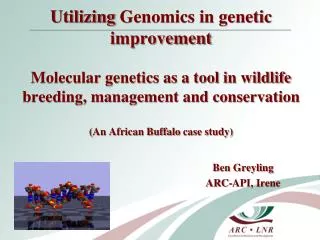
Utilizing Genomics in genetic improvementMolecular genetics as a tool in wildlife breeding, management and conservation (An African Buffalo case study) Ben Greyling ARC-API, Irene
Menu • Role of Mol. Gen. in wildlife management/conservation/breeding • The ABC of DNA • The African buffalo: A case study • Genomics: Where do we stand? • The Cattle model: from genetic variation, to marker assisted selection to quantitative variation • Cape buffalo – recent developments
Primary objective of conservation and management To protect diversity, ensure sustainable use of the resource • Driving forces: need to qualify and quantify Role of Mol tools: Supply baseline info • Levels of genetic variation, inbreeding • Pop structure – genetic distances/assignment? • Gene flow between populations? • Effective population size vs. census size • Admixture (Genomics..) • Relationship between variation and fitness/adaptation • Gene regulation/expression under environmental control
More applications… • Forensics and traceability: Individual ID • Parentage verification (selection and management tool) • Hybrid identification • Genomics: Quantitative variation – from genotype to phenotype • Epigenetics: Environments effect on genes - heritable trait expression..
…AACGTGTTGACGCCGTAATGCATAATCTHISWILLEVENTUALLYDRIVEYOUCRAZYCGCTAGCCTTCGGCAATC...…AACGTGTTGACGCCGTAATGCATAATCTHISWILLEVENTUALLYDRIVEYOUCRAZYCGCTAGCCTTCGGCAATC... The value of Mol Gen tools: Making sense of “useless information”
3000 000 000 letters per cell… T Point mutation (SNP) deletion A A C G C T T A G C T A G C T C A T T G C G AAT C G A T C G A G T insertion
African buffalo: A major role player in our ecosystems/metapopulation • Largest populations confined to conservancies • Model species with regard to pop. dynamics - factors affecting it • Genetic variation, structure, gene flow, disease status, etc. Contributed immensely to conservation and management strategies
Case studies: Population structure • KNP vs. HiP 99% accurate assignment of individuals to pops due to genetic distance
Case studies: Genetic variation Periods of low Ne for some populations in SA: ?? sustainability of genetic variation ?? compromised adaptation in response to changing environment? Example: Genetic erosion in HiP: 1% per year
East vs. southern African subpopulations? • Little genetic differentiation • East/southern African population a separate management unit, differ substantially from central/west African lineage • Substantial variation in both sub-populations
Gene expression/regulation: The Y-Chromosome • Its raining men • Environment and body condition: switch on/switch off… • Sex ratio distorted: more males in the wet season • Particular genotypes dominate depending on environment (season) – affect sex ratio • Sex ratio and BTB-link?
Heterozygote-fitness-correlation (HFC) • Low genetic variation = low body condition – affect genes on the “Y” • Bad genes expressed in southern KNP, link to BTB, what the Y is going on?…. • Females can also affect sex ratio… • Epigenetic factors? • BTB susceptibility may have an epigenetic link – heritable..
Ranches: management-scenario’s • Small populations, restricted gene flow • Controlled breeding (non-random mating) • Fragmented populations and “lines” • Breeding and selection among “lines”, e.g. Addo-Lowveld • Preference for market-desired phenotypes
Potential consequences of ranching • Reduction in genetic variation (inbreeding?) • Increase in frequency of deleterious alleles • Loss of adaptive genes/fitness • disease resistance, reproduction, growth etc. • Reduction in effective pop size – sustainability of variation? • Admixture – potential outbreeding depression • Compromised adaptability
Genomics to the rescue: Linking the DNA code to performance and phenotype (amongst others…) • SNP vs. full genome sequences – from a good amount of info to a desired amount of info • Powerful tools to address needs of wildlife industry • Substantially applied to livestock • Quantitative genetics: Selection tool for superior genetics • Fast track genetic improvement
Genomics for buffalo? • 3K SNP panel already developed identified using next generation sequencing technology • Projects in pipeline using the 3K panel = more powerful approach • Buffalo and quantitative genetics: Breeding values on the horizon? • Scope for genomic breeding values…
Requirements for Genomics: • Accurate pedigrees • Phenotypic records • Reference populations • DNA (SNP) profiles • Test populations
The future is now with this technology Are we ready to adopt?