Fostering Creativity Through Diversified Experiences
Explore how diverse life experiences foster creativity, correlational and experimental research, impactful factors, and the role of personal backgrounds in creativity development.

Fostering Creativity Through Diversified Experiences
E N D
Presentation Transcript
Diversifying Experiences and Creativity: Correlational and Experimental Research
Introduction to Problem • Creativity: • Three criteria: • Originality • Utility • Surprise • Two assessments • Personal: “little-c creativity” • Consensual: “Big-C Creativity”
Introduction to Problem • Diversifying experiences • events or circumstances that disrupt conventional and/or fixed patterns of thinking, thus enabling a person to view the world in multiple ways • short- and long-term effects
Introduction to Problem • Propositions: • Diversifying experiences → creativity • This positive effect stronger for • artistic than for scientific creativity • Big-C than for little-c creativity
Literature review • Correlational research • Experimental research
Correlational research • Historiometric research • Psychometric research
Historiometric research • Influential factors • Aggregate level • Individual level • Important precautions
Historiometric research • Influential factors • Aggregate level: • Political fragmentation • Imperial instability • Civil disturbances • Ideological diversity • Cultural heterogeneity • outside influence • travel abroad • eminent immigrants
Historiometric research • Influential factors • Individual level: • Familial unpredictability • Parental diversity • Opinionated parents • Economic ups and downs • Geographic mobility • Early traumatic experiences • e.g., parental loss
Historiometric research • Influential factors • Individual level: • Familial unpredictability • Physical or cognitive disability • Psychopathology
Historiometric research • Influential factors • Individual level: • Familial unpredictability • Physical or cognitive disability • Psychopathology • Immigration and minority status • Study abroad • Multiple role models and mentors • Omnivorous reading • Professional marginality
Historiometric research • Important precautions • Multiple determinants • Positive (accentuating) • Negative (dampening) • Nonlinear functions • Optimal level: “just right” • Optimum dependent on the • Domain: e.g., science vs. art • Person: e.g., “accommodation power”
In quiet, uneventful lives the changes internal and external are so small that there is little or no strain in the process of fusion and accommodation; in other lives there is great strain, but there is also great fusing and accommodating power; in others great strain with little accommodating power. A life will be successful or not according as the power of accommodation is equal to or unequal to the strain of the fusing and adjusting internal and external changes. -- Samuel Butler, The Way of All Flesh (1906)
Psychometric research • Cognitive disinhibition • reduced latent inhibition • enhanced allusive thinking • Bilingualism and multilingualism • but must be fully functional • and must be separated from … • Multiculturalism • increased with duration • moderated by experiential openness
Experimental Research • Group creativity • Membership diversity • e.g., age, gender, ethnicity, training … • Individual creativity • Bicultural identity • contingent on identity blendedness • Schema violation • Physical • Cultural
Conclusion • Taking altogether, correlational and experimental research supports the proposition that diversifying experiences increase creativity • However, this impact appears stronger in • the arts than in the sciences • Big-C than in little-c creativity
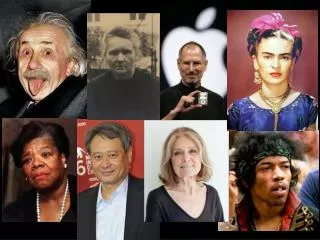
Illustration: Maya Angelou • Born St. Louis • Father doorman and Navy dietition • Mother nurse and card dealer • Age 3: Parents’ "calamitous marriage“ ended; father shipped her and older brother alone on a train to Stamps, Arkansas, to live with her paternal grandmother; experienced the brutality of racial discrimination
Illustration: Maya Angelou • Age 7: Father arrives unannounced and returns them to their mother in St. Louis • Age 8: Sexually abused and raped by mother’s boyfriend; told brother, and eventually the boyfriend was killed; she goes mute for almost 5 years, and father sends her back to their grandmother
Illustration: Maya Angelou • Age 14: Moved back with mother, who now lived in Oakland, California • Age 16: Dropped out of school to work as first African-American female streetcar conductor in San Francisco • Age 17: Her son born • Age 17-19: Mother’s life declined into poverty and crime
Illustration: Maya Angelou • And now? • A celebrated memoirist, poet, novelist, educator, dramatist, producer, actress, historian, filmmaker, and civil rights activist