
SlideServe
Menu
Préférences
© SlideServe · v2026

Field-Programmable Logic Devices: An Overview

mcgrathr avatar
20 diapositives · 403 Views · Jan 05, 2020

Learn about FPLA circuits, PROM applications, PAL examples, and ROM technologies. Explore the design process in PLD technologies.
Field-Programmable Logic Devices: An Overview - slide 1
01 / 20Field-Programmable Logic Devices: An Overview
1 / 17

Télécharger la présentation

Field-Programmable Logic Devices: An Overview
Une image / un lien ci-dessous est fourni (tel quel) pour télécharger la présentation

Politique de téléchargement : le contenu du site vous est fourni TEL QUEL pour votre information et votre usage personnel ; il ne peut être vendu, concédé sous licence ni partagé sur d’autres sites sans l’accord de son auteur.Le contenu vous est fourni TEL QUEL, pour votre information et votre usage personnel uniquement. Téléchargez la présentation en cliquant sur ce lien. Lors du téléchargement, si vous ne parvenez pas à télécharger une présentation, l’éditeur a peut-être supprimé le fichier de son serveur.Pendant le téléchargement, si vous ne parvenez pas à obtenir une présentation, le fichier a peut-être été supprimé par l’éditeur.

F I N

Plus de contenu associé

Transcription de la présentation
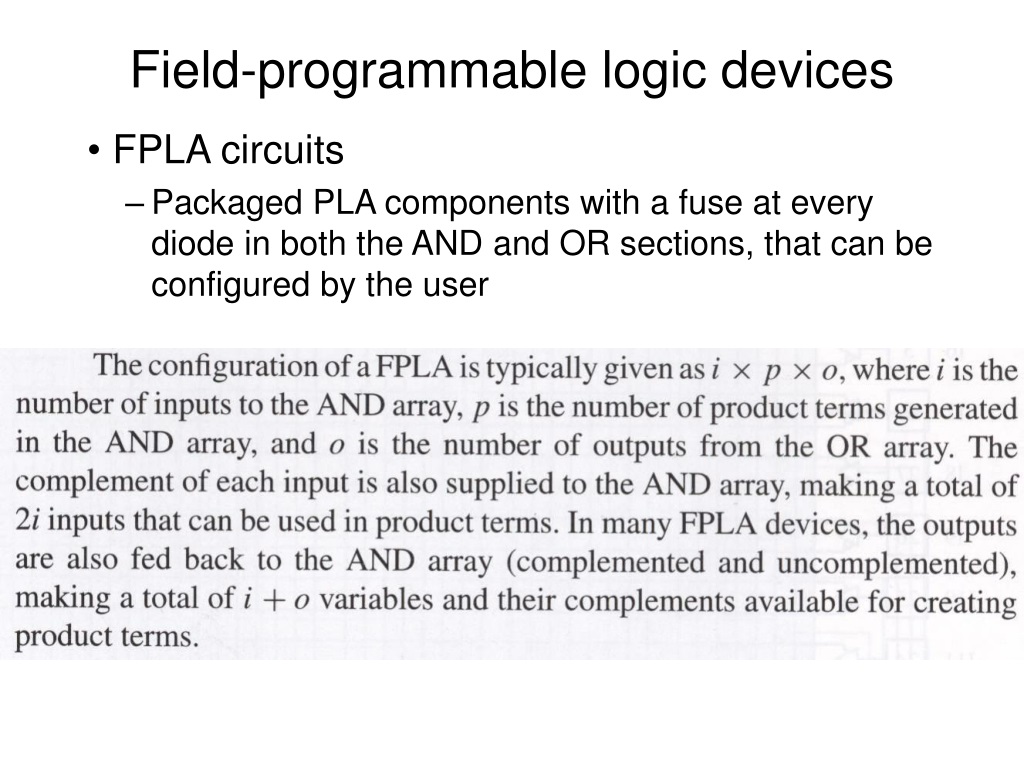
  1. Field-programmable logic devices • FPLA circuits • Packaged PLA components with a fuse at every diode in both the AND and OR sections, that can be configured by the user

  2. FPLA • Philips PLS100 FPLA

  3. FPLA • Realizing functions f1, f2 and f3 with Philips PLS100 FPLA

  4. Programmable Read-Only Memory PROM: fixed AND array and programmable OR array Generates all minterms Can realize k functions

  5. Programmable Read-Only Memory One can directly implement a SOP expression from its minterms using a PROM Is minimization useful with a PROM?

  6. Programmable Read-Only Memory • The AND array provides all 2n minterms • i.e. equivalent to n  2n decoder • Typically no polarity/feedback options • No advantage in minimizing the logic function when using a PROM • Effective for applications that require most minterms to be used • Code converters • Decoders • Lookup tables

  7. PROM application • Gray code generator using a PROM • 15 out of the 16 minterms are used in at least one output (which minterm is not used?) • Therefore, a PROM is not a “waste” for this problem

  8. PROM application

  9. PROM application • Lookup tables

  10. PROM application • Lookup table usage example

  11. PROM application • Multiplier implementation using PROMs • PROMs 1 to 4 are multipliers

  12. Multiplier elucidation An-1…n/2 An/2…0 n bits  low high n/2 bits X n bits + n+1 bits 3n/2 bits 3n/2 bits 2n bits = 3n/2 + n/2 AH AL BH BL W = ALBL X = AHBL U = X + Y Y = ALBH V = Z*2n/2 + WH Z = AHBH T = U + V R = T*2n/2 + WL

  13. PROM application • Read-Only Memory slightly modified

  14. Programmable Array Logic • Fixed OR array, programmable AND array • Limited number of product terms • Product terms cannot be shared • Designer just selects products • More compact and cheaper than a PROM

  15. Programmable Array Logic • Because of fixed OR, the standard representation for PALs is with OR gates

  16. PAL example

  17. ROM technologies • For n inputs and k outputs PROM, what would be the total • Number of diodes? • Number of fuses? • Mask programmed ROM • No user-programmable fuses • Custom mask places wires at fabrication time • Compact and fast • Useful only if sold in large volume, otherwise PROM cheaper

  18. ROM technologies • EPROM - can be erased by UV light and re-programmed • EEPROM - electrically erasable and re-programmable • Both EPROM and EEPROM have relatively short lives: not as permanent as a blown fuse • Complex and slower than ROM • Flexible: can be re-used in iterative design

  19. ROM technologies • Answer: • AND array: 2n2n diodes • OR array: k2n diodes and k2n fuses PROM PAL FPLA Fixed AND OR - Programmable OR AND AND, OR • FPLA: introduced 1975 • Organized ipo • Does FPLA implementation benefit from minimizing “literals”?

  20. PLD design process