
SlideServe
Menu
Préférences
© SlideServe · v2026

WILD LAW INTERNATIONAL RESEARCH PROJECT 2009

mckenzie-hardin avatar
15 diapositives · 336 Views · Oct 25, 2014

WILD LAW INTERNATIONAL RESEARCH PROJECT 2009. Authors: Begonia Filgueira, Filiguera, Eric Ltd: www.eric-group.co.uk Ian Mason, Gaia Foundation: www.gaiafoundation.org. What is Wild Law?. Wild as in ‘from nature’ Based on Earth Jurisprudence Redefines human / Earth relationship
WILD LAW INTERNATIONAL RESEARCH PROJECT 2009 - slide 1
01 / 15WILD LAW INTERNATIONAL RESEARCH PROJECT 2009
1 / 17

Télécharger la présentation

WILD LAW INTERNATIONAL RESEARCH PROJECT 2009
Une image / un lien ci-dessous est fourni (tel quel) pour télécharger la présentation

Politique de téléchargement : le contenu du site vous est fourni TEL QUEL pour votre information et votre usage personnel ; il ne peut être vendu, concédé sous licence ni partagé sur d’autres sites sans l’accord de son auteur.Le contenu vous est fourni TEL QUEL, pour votre information et votre usage personnel uniquement. Téléchargez la présentation en cliquant sur ce lien. Lors du téléchargement, si vous ne parvenez pas à télécharger une présentation, l’éditeur a peut-être supprimé le fichier de son serveur.Pendant le téléchargement, si vous ne parvenez pas à obtenir une présentation, le fichier a peut-être été supprimé par l’éditeur.

F I N

Plus de contenu associé

Transcription de la présentation

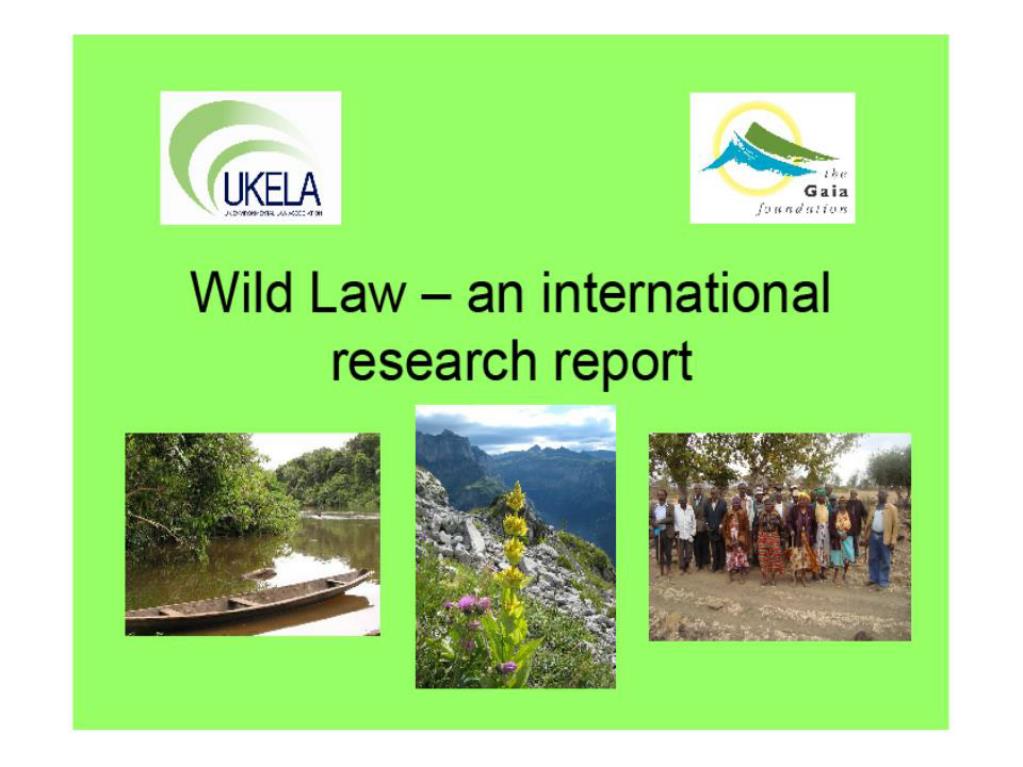
  1. WILD LAW INTERNATIONAL RESEARCH PROJECT2009 Authors: Begonia Filgueira, Filiguera, Eric Ltd: www.eric-group.co.uk Ian Mason, Gaia Foundation: www.gaiafoundation.org

  2. What is Wild Law? Wild as in ‘from nature’ Based on Earth Jurisprudence Redefines human / Earth relationship Who is my neighbour?

  3. Aims of Project Distil Wild Law theories and develop indicators that could be used to understand, assess and draft wild laws Explore the extent to which Wild Law already exists. Assess the practicality of Earth jurisprudence

  4. Indicators Earth Centred Governance Mutually Enhancing Relations Community Ecological Governance

  5. Earth Centred Governance Respect the Earth for its own value not for what it can do for us Predominant rationale environmental protection Governance informed by laws of nature Respect Earth rights

  6. Earth Rights Right to be Right to habitat Right to fulfil its role in the Earth community

  7. Mutually Enhancing Relations Recognise interconnectedness and reciprocity Conflict resolution mechanisms and restorative justice Ensure flexibility to adapt to change

  8. Community Ecological Governance Participation of all members of the Earth community Provision for public participation – access to justice, decision making, Respect for local lore, communities and local knowledge

  9. What it isn’t! South African Constitution: “Everyone has the right – (a) to an environment that is not harmful to their health or well-being; and (b) to have an environment protected for the benefit of present and future generations through reasonable legislative and other measures …” (S.24 – Environment)

  10. EU Mountain Farming Protocol 2006 Preamble: “…by virtue of its wealth of natural resources, water resources, agricultural potential, historical and cultural heritage, value for quality of life and for economic and leisure activities and the transport routes crossing it, the Alpine region will continue to be of vital importance …”

  11. Best examples:K M Chinnappa v Union of India Appellant required to Cease mining operations Fund site rehabilitation plan Pay compensation for benefit of national park Wind up and transfer infrastructure to Forest Department

  12. NZ National Parks Act 1980 National parks to be protected for their “intrinsic worth” Integrates Treaty of Waitangi Damage restorative Public participation

  13. CONCLUSIONS Different perspective of EJ No really serious Wild Law anywhere No real acknowledgement of rights or intrinsic value of Nature Some recognition of interdependency Wildness arises from extreme situations

  14. Further Thoughts Support call for Universal Declaration of Rights of Nature Support Nature’s Rights Act or constitutional rights for Nature Make right to protect the environment part of the right to life Use Wild Law principles of interpretation Stop calling the Earth a resource Consumer discrimination Engage with Nature