Balancing Power in Education: The Teacher's Role, Evaluation Purpose, and Content Impact
This comprehensive exploration delves into the balance of power in educational settings, highlighting the teacher's pivotal role in guiding learning and evaluation. It emphasizes the importance of content choice in fostering motivation and active learning, which is crucial for developing independent learners. By examining various influential factors—including environmental, content, course, and student characteristics—the text provides valuable insights into creating effective instructional environments. Understanding these dynamics can enhance the educational experience and promote deeper learning outcomes.

Balancing Power in Education: The Teacher's Role, Evaluation Purpose, and Content Impact
E N D
Presentation Transcript
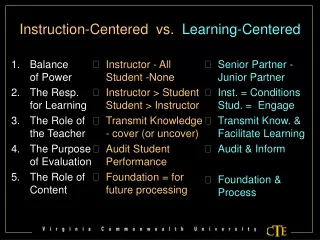
Balance of Power The Resp. for Learning The Role of the Teacher The Purpose of Evaluation The Role of Content Instructor - All Student -None Instructor > StudentStudent > Instructor Transmit Knowledge- cover (or uncover) Audit Student Performance Foundation = for future processing Instruction-Centered vs. Learning-Centered • Senior Partner -Junior Partner • Inst. = ConditionsStud. = Engage • Transmit Know. &Facilitate Learning • Audit & Inform • Foundation & Process
Balance of Power The Responsibility for Learning The Role of the Teacher The Purpose of Evaluation (Assessment) The Role of Content Choice = Motivation Active Learning = Deeper Learning Facilitation = Independent Learners Feedback (Data) = Inform and Development Content (Info) = Meansfor promoting skills MaryEllen Weimer5 key areas of change
Factors to Consider • Environmental / Architectural • Content Characteristics • Course Characteristics • Profession / Discipline Characteristics • Student Characteristics • Instructor Characteristics • Situational Factors
Power Responsibility Role of Inst. Role of Eval. Role of Content Large Introductory Lecture ICT LCT
Power Responsibility Role of Inst. Role of Eval. Role of Content Upper-level Seminar ICT LCT