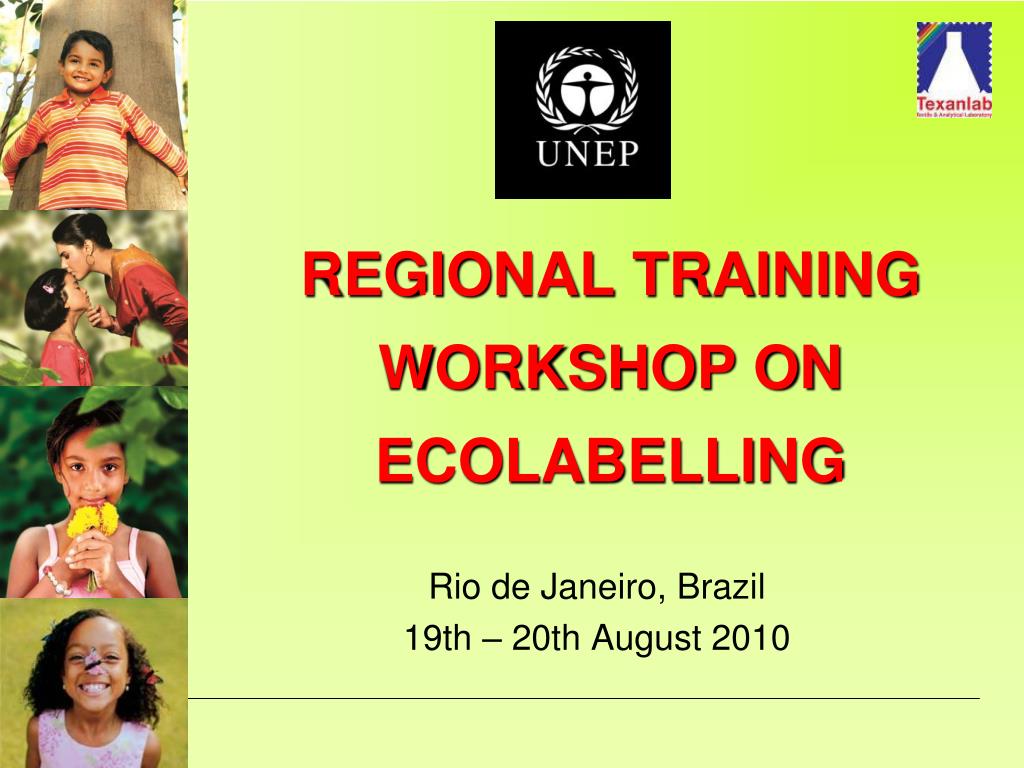
Join us for a regional training workshop on ecolabelling in Rio de Janeiro, Brazil. Learn about the EU Flower criteria for textiles, application processes, legislation, and more. Interactive exercises included.
01 / 142Eco-friendly Textiles: EU Flower Criteria Workshop
1 / 17
Télécharger la présentation
Eco-friendly Textiles: EU Flower Criteria Workshop
Une image / un lien ci-dessous est fourni (tel quel) pour télécharger la présentation
Politique de téléchargement : le contenu du site vous est fourni TEL QUEL pour votre information et votre usage personnel ; il ne peut être vendu, concédé sous licence ni partagé sur d’autres sites sans l’accord de son auteur.Le contenu vous est fourni TEL QUEL, pour votre information et votre usage personnel uniquement.Téléchargez la présentation en cliquant sur ce lien.Lors du téléchargement, si vous ne parvenez pas à télécharger une présentation, l’éditeur a peut-être supprimé le fichier de son serveur.Pendant le téléchargement, si vous ne parvenez pas à obtenir une présentation, le fichier a peut-être été supprimé par l’éditeur.
Agenda • Introduction / participants • Key documents and Eco-label website • Eco-label criteria for Textiles • Application process for EU Eco-label • Exercises • Legislation and the EU Flower
2. Relevant documents • A) Criteria document • B) User Manual / Application pack • C) How to find documents, contacts, news, other license keepers, potential customers at the webpage
2 A) Criteria document • Available in different languages • Consists of two parts: • The Commission decision • Product group definition • Validity information • Annex • Framework • Criteria
2 A) Criteria • First issued 2002, valid until 2007 • Extended in 2007 • Extended in 2008 • CURRENT CRITERIA : 9 July 2009, 2009/567/EC
2 B) User Manual / Application Pack • Help & guidance, prefabricated declarations (including no-use) • Part A: General • Part B: Specific for textiles: • Description of the product • Fibres • Processes, chemicals and reporting energy and water consumption • Fitness for use • Information on label
2 B) User Manual / Application Pack • Part B: Detailed information for applicants • The criterion • Exceptions • Assessment and verification • Test requirements • Requirements for applicants
2 C) EU Ecolabel Website • http://ec.europa.eu/environment/ecolabel/ • Information & Background • Documents Download • Application procedures • Brochures • Useful links • FAQ • Policies
2 C) EU eco-label website • www.eco-label.com • Search a Product • Search for Manufacturers • Browse Labelled Products • Take a Quiz !
What are Medium, Small & Micro Enterprises ? < 250 Employees Turnover < 40 Mio EUR • Less than 50 employees • Annual Turnover < 7 Mio EUR or • Annual Balance Sheet < 5 Mio EUR • Less than 10 employees
EU Flower for textiles is applicable to : • Products with min 90 % textile fibres • Textile Clothing • Accessories for Clothing (Handkerchiefs, Scarves, Bags and Shopping Bags, Rucksacks, Belts etc. • Interior Textiles (excl wall and floor coverings) • Fibres, Yarn & Fabrics for above.
90 % textile … • Down, feathers, membranes and coatings need not be taken into account in the calculation of the percentage of textile fibres.
Criterion 1: Acrylic The residual acrylonitrile content in raw fibres < 1,5 mg/kg. (b) The emissions to air of acrylonitrile < 1 g/kg of fibre produced, expressed as an annual average.
Criterion 2: Cotton and other natural cellulosic seed fibres (including kapok) • Cotton and other natural cellulosic seed fibres (hereinafter referred to as cotton) shall not contain more than 0,05 ppm of different pesticides mentioned. • No pesticide tests if > 50 % of the cotton content is organically grown cotton or transitional cotton. • No pesticide tests if > 75% identified farmers with no use of the mentioned pesticides.
Criterion 2 (Cotton) – Use of Organic Cotton • For > 95 % certified organic cotton, allowed to write ‘organic cotton’ next to the eco-label. • For between 70 & 95 % certified organic cotton, allowed to write “made with x% organic cotton”.
Criterion 3: Elastane • (a) Organotin compounds shall not be used. • (b) The emissions (air) of aromatic diisocyanates < 5 mg/kg of fibre produced, expressed as an annual average.
Criterion 4: Flax and other bast fibres (including hemp, jute, and ramie) • No water retting allowed, unless:Effluent water is treated to reduce the COD/ TOC by at least • 75 % (for hemp) • 95 % (for flax and the other bast fibres)
Criterion 5: Greasy wool and other keratin fibres (including wool from sheep, camel, alpaca, goat) • Restrictions on sum total content of specified pesticides on raw wool. • No pesticide test if > 75% identified farmers with no use of the mentioned pesticides. • Scouring effluent discharge restrictions also apply.
Criterion 5 (wool) - continued Scouring effluent discharged : • COD < 60 g/kg greasy wool, and • the effluent shall be treated off-site with > 75 % reduction of COD, expressed as an annual average. Scouring effluent treated on site and discharged to surface waters: • COD < 5 g/kg greasy wool • pH 6 - 9 • temperature < 40 °C
Criterion 6: Man-made cellulose fibres (including viscose, lyocell, acetate, cupro, triacetate) • (a) AOX in the fibres < 250 ppm. • (b) Viscose:Sulphur content of the emissions of sulphur compounds to air < 120 g/kg filament fibre produced and < 30 g/kg staple fibre produced, expressed as an annual average.
Criterion 6 (cellulose) - continued • (c) Viscose:Zinc emission (water) < 0,3 g/kg, expressed as an annual average. • (d) Cupro fibres:copper content of the effluent water leaving the site < 0,1 ppm, expressed as an annual average.
Criterion 7: Polyamide N2O emissions (air): • < 10 g/kg polyamide 6 fibre produced • < 50 g/kg polyamide 6,6 produced expressed as an annual average.
Criterion 8: Polyester • Antimony in the polyester fibres < 260 ppm. Where no antimony is used, the applicant may state ‘antimony free’ (or equivalent text) next to the eco-label.
Firstly • The following criteria apply to all stages of production of the product. • But recycled fibres may contain some of the dyes or other substances excluded by these criteria, if from their previous life-cycle.
Criterion 10: Auxiliaries and finishing agents for fibres and yarns Sizing compounds • At least 95 % of formulation shall be sufficiently biodegradable or recycled • Sum of all components of the formulation to be taken into account.
Criterion 10: (Auxiliaries) - cont Spinning auxiliaries and additives used in primary spinning • At least 90 % components should be sufficiently biodegradable or eliminable. • Content of PAH must be less than 3 % in mineral oil used.
Criterion 13: Weighting • Compounds of cerium shall not be used in the weighting of yarn or fabrics.
Criterion 14: Auxiliary chemicals Preparations/formulations may not contain: • APEOs • LAS • DTDMAC • DSDMAC • DHTDMAC • EDTA • DTPA
Criterion 15: Detergents, fabric softeners and complexing agents At each wet-processing site, at least 95 % by weight of : • detergents, • fabric softeners • complexing agents shall be degradable / eliminable. (Surfactants used must be ultimately biodegradable, aerobically)
Criterion 16: Bleaching agents • Chlorine bleach not to be used. • This requirement does not apply to the production of man-made cellulose fibres (viscose, acetate, lyocell etc.) • Section 6.1 requirement, AOX to be less than 250 ppm is however applicable.
Criterion 20: Metal complex dyes • If metal complex dyes based on copper, chromium or nickel are used: • For Cellulose dyeing:< 20 % of dyes shall be discharged to waste water. • For all other fibres< 7 % of dyes shall be discharged to waste water.
Criterion 20: (metal complex dyes) - cont • Effluent discharge after treatment should not contain more than • 75 mg/kg of Cu • 50 mg/kg of Cr • 75 mg/kg of Ni • On weight of fibre, yarn or fabric
Criterion 21: Azo dyes • Dyes which cleave to form specified banned amines should not be used.
Connexion au compte
Connectez-vous pour publier votre contenu sur SlideServe.