Understanding Dendritic Spines: Structure, Function, and Synaptic Plasticity
This overview discusses the structural and functional characteristics of dendritic spines, which are essential post-synaptic sites for excitatory neurotransmission. The variety of spine shapes and sizes raises questions about their functional significance, as most principal neurons exhibit spines, while GABAergic neurons are typically aspiny. Dendritic spines feature organelles like smooth ER, polyribosomes, and are closely associated with presynaptic active zones. These highly dynamic structures are crucial for synapse-specific signaling and may play a key role in experience-dependent morphological changes linked to memory.


Understanding Dendritic Spines: Structure, Function, and Synaptic Plasticity
E N D
Presentation Transcript
Synaptic Plasticity III 4 April 2012
Housekeeping • NO LABS THIS WEEK! • No lab 8 assignment due • No class until next Wednesday • Have a happy Easter! • But a sad Good Friday! • Problem Set 3 and Article Set 3 are available • Problem Set 3 consists of questions about Article Set 3
General Features of the Postsynaptic Specialization • Soma and dendrites are the predominant postsynaptic sites • Inhibitory synapsesare typically found on proximal dendrites and the soma • Excitatory synapses are typically found on spineson distal dendritic branches
Dendritic Spines: Structure and Function • Spines come in a variety of shapes and sizes • Functional significance of variety unclear • Most principle neurons display spines • Typically, GABAergic neurons do not display spines (aspiny) • Spines, therefore, represent the major postsynaptic site for excitatory input
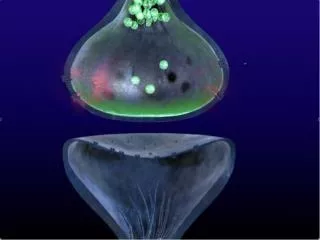
Dendritic Spines:Structure and Function • Spines contain organelles: • Smooth ER—intracellular Ca2+ source • Polyribosomes and vesicles • Spines display the PSD • Approximately 10% of spine surface area • Precisely aligned with presynaptic active zone • Often associated with cell-cell adherens junctions
Dendritic Spines:Structure and Function • Each spine usually represents no more than a single synapse • Suggests synapse-specific signalling: Spines act as both segregators and integrators of synaptic signals • Spines are highly dynamic (seconds to minutes) through both activity-dependent and –independent mechanisms • Convincingly show experience-dependent morphological changes—memory?