Download
1 / 6
60 likes | 174 Vues
On March 19, 2003, President George W. Bush initiated the invasion of Iraq, citing the need to find weapons of mass destruction. The aftermath of this military action led to significant loss of life, with 135 U.S. service members tortured and killed. The political landscape of Iraq transformed with leaders like President Jalal Talabani and Prime Minister Nuri al-Maliki assuming power. Iraq's governance transitioned into a parliamentary democracy, characterized by an independent judiciary and an elected Council of Representatives. This narrative focuses on the complexities of war and its long-lasting impacts.

E N D
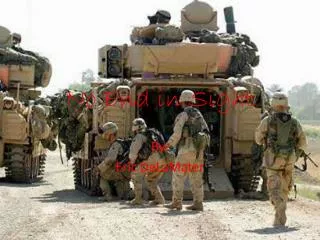
No End in Sight By: Eric DeLaMater
Invasion of Iraq • March 19th, 2003: President Bush launches and invasion of Iraq. He heard that there were weapons of mass destruction located somewhere in Iraq, so we had to find them. • He stated we found them May 29th, in 2003. • 135 US service members were tortured and lost their lives.
Political leaders of Iraq • President--Jalal TalabaniVice Presidents--pendingPrime Minister--Nuri al-MalikiDeputy Prime Minister--Husayn al-ShahristaniDeputy Prime Minister--Rowsch Nuri ShawaysDeputy Prime Minister--Salih al-MutlaqMinister of Defense--pendingMinister of Finance--Rafi al-IssawiMinister of Foreign Affairs--Hoshyar Mahmud ZebariMinister of Interior--pendingMinister of Oil--Abd al-Karim al-Luaybi
Government of Iraq • Iraq is a parliamentary democracy with a federal system of government. • Iraq's legislative branch consists of an elected Council of Representatives. • Iraq's judicial branch is independent. • Iraq’s executive branch includes head of government, cabinet, and elections.
Sources • http://www.cfr.org/iraq/timeline-iraq-war/p18876?gclid=CIfR2qWGmKwCFcFw4Aodn085PA • http://www.state.gov/r/pa/ei/bgn/6804.htm