Understanding Memoirs: Structure, Dialogue, and Revising Techniques
80 likes | 204 Vues
This lesson focuses on the art of writing a memoir, highlighting its narrative quality, character development, and plot emphasis. Students will learn to identify the subject and verb within sentences, making connections to their understanding of storytelling. Key components of a memoir, such as dialogue, will be covered, including writing techniques and quotation rules. The lesson aims to refine students' memoir drafts according to established rubrics, reinforcing their writing skills. Students will engage in comparisons with existing texts to enhance their writing abilities.


Understanding Memoirs: Structure, Dialogue, and Revising Techniques
E N D
Presentation Transcript
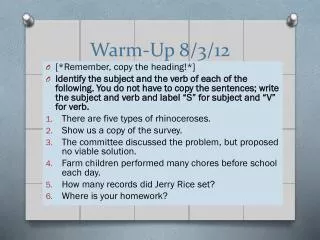
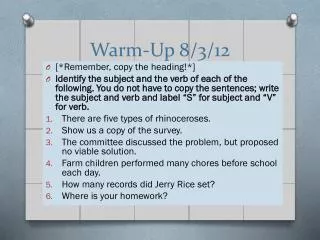
Warm-Up 8/3/12 • [*Remember, copy the heading!*] • Identify the subject and the verb of each of the following. You do not have to copy the sentences; write the subject and verb and label “S” for subject and “V” for verb. • There are five types of rhinoceroses. • Show us a copy of the survey. • The committee discussed the problem, but proposed no viable solution. • Farm children performed many chores before school each day. • How many records did Jerry Rice set? • Where is your homework?
Memoir • …1stperson account of own [portion of] life • Narrow focus: 1 theme/perspective • not whole story of a life, only interesting stories. • root word: “memory.” • not about reporting facts. • memoir not necessarily full of lies, but a memoir is not about what happened so much as how it happened. To the author. • And because of that… a memoir may not be all true. • are memories factually accurate? NO.
(more on memoir) • Similar to fiction: • a good memoir will have a strong narrative • emphasis on character and plot. • Not like nonfiction: • An autobiography can get away with presenting a life as a series of events and facts and figures. • A memoir has to tell a story.
More practice… • Read the simple excerpt from House on Mango Street. • Answer the questions that follow—write on this! Work with a neighbor. • Goal: compare to Chinese Cinderella so we can come up with a rubric for our own drafts.
Dialogue What is it? Why would a writer include it? When would it not be in a story? How do you write it?
Dialogue noteshttp://garvoille.wordpress.com/page/17/ • Put the spoken words and punctuation in quotes. • Capitalize the first letter of the quotation. • ex: “Hey.” • Add a dialogue tag when needed. • Include punctuation before and after the quotation. • Before ex: He said, “Hey.” He said, “Hey!” • OR After ex: “Hey,” he said. “Hey!” he said. • Start a new paragraph when you switch speakers. • “Hey,” she said, “wait.” He responded, “Well?”
Closure and Reminders • What are the basic elements of a memoir? • HW: • Make notes and revisions to memoir so that it meets our “rubric” requirements. Bring this back to class on Monday. • Bring Chinese Cinderella on Monday!