Download
1 / 2
20 likes | 151 Vues
This research explores the innovative use of oxide-based nanoparticles, like zirconia, as seeds for carbon nanotube (CNT) growth, challenging traditional metal-based catalysts. The study reveals that CNT growth dynamics depend significantly on new, recently discovered conditions influenced by nanostructure parameters. The work utilizes advanced in situ metrologies (XPS, ETEM) to uncover the formation mechanisms of carbon-based materials, including single- and multi-walled CNTs, and graphene from hafnia. This research supports new collaborative efforts and advances in composite material applications.

E N D
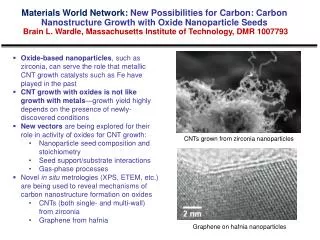
Materials World Network: New Possibilities for Carbon: Carbon Nanostructure Growth with Oxide Nanoparticle Seeds Brain L. Wardle, Massachusetts Institute of Technology, DMR 1007793 • Oxide-based nanoparticles, such as zirconia, can serve the role that metallic CNT growth catalysts such as Fe have played in the past • CNT growth with oxides is not like growth with metals—growth yield highly depends on the presence of newly-discovered conditions • New vectors are being explored for their role in activity of oxides for CNT growth: • Nanoparticle seed composition and stoichiometry • Seed support/substrate interactions • Gas-phase processes • Novel in situ metrologies (XPS, ETEM, etc.) are being used to reveal mechanisms of carbon nanostructure formation on oxides • CNTs (both single- and multi-wall) from zirconia • Graphene from hafnia CNTs grown from zirconia nanoparticles Graphene on hafnia nanoparticles
Materials World Network: New Possibilities for Carbon: Carbon Nanostructure Growth with Oxide Nanoparticle Seeds Brain L. Wardle, Massachusetts Institute of Technology, DMR 1007793 • Research on oxide-based CNT growth is fueling novel capabilities for advanced composites • Research served as the basis for K-12/public outreach at the 2011 MIT150 Open House (150th year celebration) • In support of emerging research needs demanded by this effort, a new CVD facility has been constructed and is facilitating collaborations with researchers: • Mechanical Engineering, • Materials Science • Chemical Engineering • Aerospace Engineering • Air Force Research Lab • Army Research Office • University of Cambridge • Industry through MIT’s Nanoengineered Composite aerospace STructures Consortium (NECST) Students present CNT research to the public at Open House New CVD facility for emerging oxide research needs