Overview of U.S. Military Structure, Service Requirements, and Training
The U.S. Armed Forces operates under the leadership of the Commander in Chief and Secretary of Defense. Recruiters attract volunteers with competitive pay and benefits, requiring a 4-year commitment and the passing of the ASVAB test. Initial training involves boot camp followed by Advanced Individualized Training in specialized roles within branches such as the Army, Navy, Marines, Coast Guard, and Air Force. Each branch has unique responsibilities, ranks, and operational specialties, focusing on national security and defense.

Overview of U.S. Military Structure, Service Requirements, and Training
E N D
Presentation Transcript
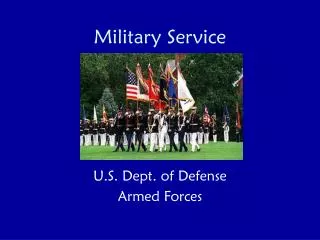
Military Service U.S. Dept. of Defense Armed Forces
Leadership 1. Commander in Chief/President 2. Sec. of Defense 3. Joint Chiefs of Staff (6 member advisory team) 4. Compartmentalized
Volunteer/Recruiting • Recruiters persuade people to join • Attractive pay & benefits • 4 year service, required • ASVAB test (Armed Services Vocational Aptitude Battery) • http://www.asvabprepinfo.com/ • boot camp training; then job training; then stationed
Selective Service Act“The Draft” • used during the Civil War • officially started in WWI, reestablished in WWII, and last use was in Vietnam, discontinued in 1973 • register: age 18-25 (MANDATORY), could be up to 35 • Exempt: females, 26+ males, students in officer programs, lawful non-immigrants, incarcerated, • Postponement: college • Reclassification: hardship with dependents, ministers of religion, conscientious objectors
Boot Camp (1) • Basic Training – initial indoctrination • Drills & psychological tests • transform civilians military personnel • lasts between 6 – 12 weeks (depending on the military branch) • Red, White, & Blue Phases
Jobs & Training (2) • (AIT) Advanced Individualized Training • train in specific chosen field in his/her MOS (Military Occupation Specialty) Stationed (3)
Army • *main branch – largest and oldest • origins: Continental Army • Specialty: land based military operations; infantry • Purpose: preserve peace and security, support national policies, implement national objectives, overcome any nations responsible for aggressive acts • Rank: Generals Lieutenants Sergeants Corporals Privates
Navy • *largest navy in the world • origins: fighting pirates (Barbary Wars) • Specialty: water based military operations • Responsibilities: prep naval forces for war, maintain aviation (including air), be equipped for naval combat • Rank: Admirals Captains Lieutenants Petty Officers Seamen
Marines (Navy) • *amphibious warfare, been in every American war & conflict, more elite (not as many members), work with all three branches • origins: infantry for navy (Barbary Wars) • specialty: provide power projection from the sea • Responsibilities: seize or defend naval bases, amphibious landings, directions from the President • Rank: General Colonel Lieutenant Sergeant Corporal Private
Coast Guard (Navy) • Dept. of Homeland Security, not DoD • *oldest seagoing service, deployed every day • Specialty: protecting our coastline • Responsibilities: maritime law enforcement, search & rescue • Rank: Lieutenant Commander Captain Admiral Petty Officer
Air Force • *initially part of Army • Origins: WWI • Specialty: Aerial warfare • Responsibilities: strategic attack, counter attack, combat support, air lift, surveillance & intelligence, weather, space craft • Rank: Generals Colonels Major Captains Lieutenants Sergeant Airmen
Special Forces • Marines: • Marine Expeditionary Unit – hostage rescues, embassy evacuations • Air Force: • Special Tactics – support the overall military campaign (recovery missions & collect intelligence) • Navy: • Seals, aka Dev Group (Sea, Air, Land) – toughest military training in the world; world’s premier warriors • Army: • *DELTA – most covert; 3 squadrons (i.e. HALO – High Altitude Low Opening) • Green Berets – specialize in working with local populations • Army Rangers – “rangers lead the way”