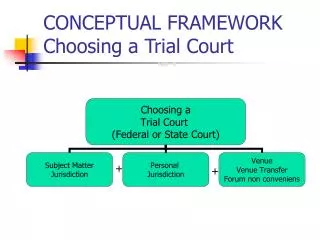
CONCEPTUAL FRAMEWORK Choosing a Trial Court
240 likes | 382 Vues
This conceptual framework explores the critical aspects of personal jurisdiction and service of process within the context of trial courts. It examines the constitutional limits of state authority and the importance of properly notifying defendants to ensure valid judgments. Key cases like Mullane v. Central Hanover are analyzed to highlight the requirements for effective notice. The framework provides insights into the implications of service methods, the evolution of principles governing jurisdiction, and practical considerations for legal professionals in navigating these complex legal processes.


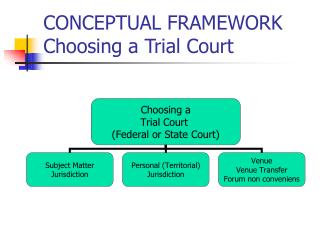
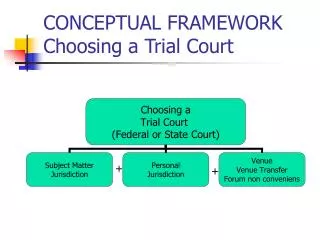
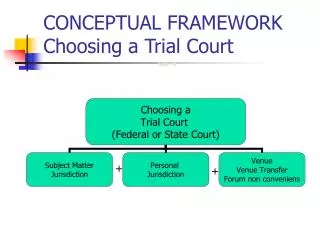
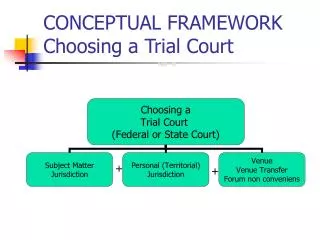
CONCEPTUAL FRAMEWORK Choosing a Trial Court
E N D
Presentation Transcript
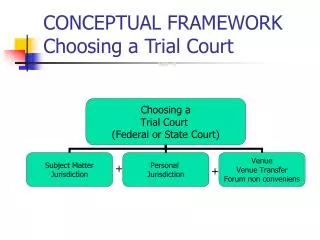
CONCEPTUAL FRAMEWORKPJ & Process Personal Jurisdiction Power Process Constitutional Limits State Authorization
CONCEPTUAL FRAMEWORKPJ & Process Constitutional Limits Limits of State Authorization
PJ: THE BIG PICTUREFunctions of Process • Assert court’s power (state sovereignty) • over defendant (or property) • Notice to defendant • defend against lawsuit • Mark beginning of lawsuit • Trigger s/l • Determine parties bound by lawsuit
PJ: THE BIG PICTURE Valid Judgments & Collateral Attack Hypothetical • Christine & Bob lived in Idaho • C moved to WA, filed dissolution • Service by publication • Default judgment against Bob • division of property • judgment against B for $
PJ: THE BIG PICTURE Valid Judgments & Collateral Attack Hypothetical (cont.) • Can Bob challenge the decree? • Decree entitled to FF&C, if valid • Not valid if: • Service of Process violates Contst. • 14th Amend. D.P.
SKILLS: READING CASES Mullane v. Central Hanover, p. 175 • Basic Case Reading • Questions
RULE CHOICEConceptual Framework Mullane v. Central Hanover B&T Co. Note 1, p. 183 • Why did drafters of N.Y. Banking Law think published notice constitutionally adequate? • Date of Mullane? • How fit into Pennoyer-Shoe conceptual framework?
SKILLS: READING CASESHistorical Background • Pennoyer Framework for Process • In personam • in-state personal service • In rem • alternative service, e.g. publication • Evolution • Consent & Domicile • Milliken, p. 103
SKILLS: READING CASES Rule Choice & Legally Significant Facts • Different categories of defendants? • i.e. beneficiaries
SKILLS: READING CASES Rule Choice & Legally Significant Facts • What notice required for • Known beneficiaries with known residence? • Known beneficiaries with unknown residence? • Future or contingent beneficiaries?
SKILLS: READING CASES Rule Choice & Legally Significant Facts • Why different forms of notice? • Better notice • Less costly notice
SKILLS: READING CASES Mullane v. Central Hanover, p. 175 • Rule Choice Possibilities • actually reach defendant • most likely to reach defendant • reasonably likely to reach defendant • might reach defendant
SKILLS: ARGUING FROM PRECEDENT • Meaning of Mullane • Different result for known defendants if • No regular mailings to beneficiaries? • Does court require actual notice?
SKILLS: ARGUING FROM PRECEDENT Hypothetical • Ms. Jones says • "I didn't get notice” and • “I object to settlement of account” • Would court vacate judgment in Mullane?
BLACK LETTER LAWDue Process Notice Requirement • Mullane Test (Memorize it!) • notice reasonably calculated • under all circumstances • to apprise parties of action, • and opportunity to present objection
SKILLS: ARGUING FROM PRECEDENT Hypotheticals • Mitchell v. Neff • Mitchell’s Affidavits • Service by mail - last known address • returned • Inquiries • rumor in hiding • Valid service?
SKILLS: ARGUING FROM PRECEDENT Hypotheticals • Neff’s affidavits • Left forwarding address • Friends deny Mitchell inquired • Not hiding • Visiting friends in SF • How does court resolve?
THE BIG PICTUREWhy do we care about notice? • Notice and Class Representatives • Why bother sending notice? • What would you do with it? • What would Ralph Nader do with it? • Deterrent effect?
CONCEPTUAL FRAMEWORKPJ & Process Personal Jurisdiction Power Process Constitutional Limits State Authorization +
SERVICE OF PROCESS • Problem Set • Comments • Questions • Organizing the information • Who, What, Where, When
SERVICE OF PROCESS Hypothetical • Plaintiff serves Steve • leaves copy with girlfriend Linda • at her house • He spends less than ½ time there • She gives him the summons & complaint
TAKEAWAYS • Black letter law • “reasonably calculated” to give notice • collateral attack • only if constitutionally invalid • Skills: Arguing from Precedent • broad & narrow case holdings • rules & standards