Exploring Place and Plexus: The 5Cs Framework of Agents and Urban Dynamics
120 likes | 222 Vues
Delve into the complex interplay of agents—individuals, firms, and governments—within urban settings through the 5Cs framework presented by David Levinson. Understand how time, money, space, and responsibility act as constraints impacting opportunities and decision-making in cities. Analyze the roles of competitors and complementors in shaping available resources and chances. Explore fundamental questions about urban existence, such as what constitutes a city, the significance of networks, and the reasons behind the growth and importance of particular urban areas like the Twin Cities and Chicago.


Exploring Place and Plexus: The 5Cs Framework of Agents and Urban Dynamics
E N D
Presentation Transcript
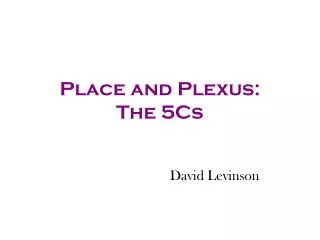
Place and Plexus:The 5Cs David Levinson
Agents • What is an agent? • What are the classes of agents: • We look at • individuals, • firms (developers, locators), and • governments as classes of agents. There are of course others (organizations), which have minor effects on Place and Plexus.
Constraints • Time [Why?] • Money [Why?] • Space [Why?] • Responsibility [Why?] • [Others?]
Chances • The set of things One can do • Activities One can pursue, • Houses One can buy, • Jobs One can hold, • Partners One can seduce etc.
Competitors • Those who compete for scarce resources • Competitors reduce available chances by increasing constraints • [Examples]
Complementors • Those who help resources become less scarce • Complementors increase available chances by pushing out constraints • [Examples]
Choices • The bundle of goods One does consume, activities One does pursue, etc. • Why are choices at the boundary of constraints? []
Why do cities/towns/places exist? • What is a city? • Why does the Twin Cities exist? • Why are the Twin Cities larger than Duluth or Fargo? • Why is Chicago more important than St. Louis? • What is inevitable, what is chance?
Why do networks exist? • What is a network? • Give examples …