Download
1 / 7
70 likes | 194 Vues
Discover the intriguing world of dingoes, Australia’s adaptable wild canines. Characterized by their yellowish coat, larger head, and long jaws compared to domestic dogs, dingoes thrive in diverse habitats from forests to coastal regions. These skilled hunters primarily feast on small to medium-sized mammals and exhibit keen senses. They mate between May and July, with females giving birth to up to ten pups. With a history in Australia dating back approximately 3,500 years, dingoes once shared close bonds with Indigenous Australians. Learn more about these remarkable creatures!

E N D
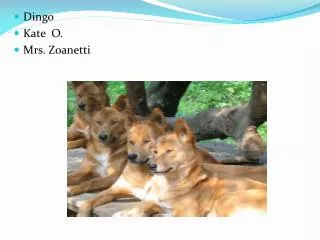
Dingo • Kate O. • Mrs. Zoanetti
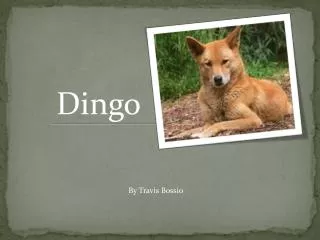
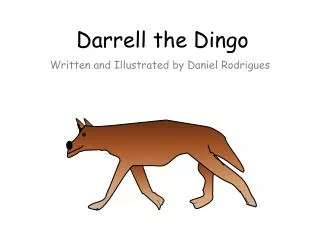
Appearance • Nine out of every ten dingoes have a yellowish coat . • Dingoes have a larger head than a domestic dog of the same body size. • They have longer teeth and a longer nose and jaws than a domestic dog of the same body size.
Habitat • Dingoes are adaptable so they can live in many places. • Dingoes live throughout Australia in forests, mountains , along the coasts, and on flat, grassy plains. • Their habitat can have trees, water, rocks, and grass.
Food and Hunting • The dingo usually eats small or medium-sized mammals such as wombats, wallibies, rabbits, and wallaroos. • In some places, it kills lizards. • Dingoes have keen eyes and ears.
Nesting Behaviors and Raising Young • Dingoes mate between May and July. • The female dingo gives birth to a litter of between one and ten pups. • Their pups are born 63 days after they mate.
Interesting Facts • Some scientists believe that the dingo is related to wild dogs that live in parts of Asia. • Dingoes have been in Australia for around 3,500 years! • Aborigines kept dingoes in their camps and the dog hunted with the men.
Resources • http://a-z-animals.com/animals/ • http://www.kidcyber.com.au/ • The Dingo, Lynn M. Stone, 1990.