Download
1 / 41
410 likes | 607 Vues
Air masses are vast bodies of air with consistent temperature and humidity levels. Their classification is primarily based on temperature (Polar, Tropical, Arctic) and humidity (Maritime, Continental). For example, continental polar (cP) air masses from northern Canada are dry and cold, potentially leading to phenomena like lake-effect snow. Fronts are transition zones between different air masses, identified by sharp changes in temperature, dew point, and wind direction. They include stationary, cold, warm, and occluded fronts, each affecting surface weather patterns differently.

E N D
Chapter 11 Air Masses and Fronts
Air Masses • Extremely large body of air whose temperature and humidity are similar horizontally and vertically. • Source Regions: area where air mass originates, usually flat and uniform composition with light surface winds
Air Masses • Classification • Classification based upon temperature and humidity • P = polar • T = tropical • A = Arctic • m = maritime • c = continental
Air Masses • North America cP and cA • Source region: N. Canada, Alaska • Dry, cold, stable (A more extreme) • Topic: Lake Effect Snow • cP air passes over unfrozen lake, absorbs moisture and drops snow on leeward side of lake
Stepped Art Fig. 11-4, p. 292
Air Masses • North American mP • Source region: North Pacific, North Atlantic • Cool, moist, unstable • North American mT • Source region: Gulf of Mexico, Caribbean, SE Pacific • Wet, warm, unstable • Pineapple Express, Bermuda High
Air Masses • North American cT • Source Region: SW US, Mexican Plateau • Hot, dry, stable
Fronts • Transition zone between two air masses of different densities • Identification on Charts • Sharp temperature change • Sharp change in dew point • Shift in wind direction • Sharp pressure change • Clouds and precipitation Frontolysis and frontogenesis
Fronts • Stationary • Front with no movement • Alternating red and blue line with blue triangles and red semi-circles • Winds parallel but opposite direction • Variable weather
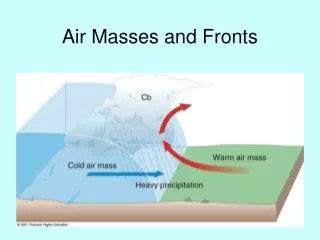
Fronts • Cold • Cold, dry stable air replaces warm, moist unstable air • Blue line with blue triangles • Clouds of vertical development • Thunderstorms, squall lines
Fronts • Warm • Warm, moist unstable air overrides cold, dry stable air • Red line with red semi-circles • Horizontal cloud development with steady rain • Topic: Dry Line • Not a cold or warm front but a narrow boundary of steep change in dew point
Fronts • Topic: Wavy Warm Front • Mountain blocking path of cold air (cold air damming) causes wave shape • Occluded Front • Cold front catches up to and over takes a warm front • Purple line with purple triangles and semi-circles • Cold occlusion, warm occlusion
Fronts • Upper-Air Fronts • Front aloft • Tropopause dips downward and folds under the Polar jet • Impacts surface weather