Download
1 / 4
40 likes | 196 Vues
This overview explores the Supreme Court's workflow, including the petition process for certiorari, the significance of the Rule of Four, and how cases progress through the Court. We discuss the grant and docketing of certiorari, the submission of briefs, and key steps such as oral arguments and opinion assignments. Additionally, we address critical questions regarding jurisdiction, original versus appellate jurisdiction, and the implications of the Judiciary Act of 1789 and Article III of the Constitution. The discussion reflects on pivotal cases like Marbury v. Madison and critiques by legal scholars.

E N D
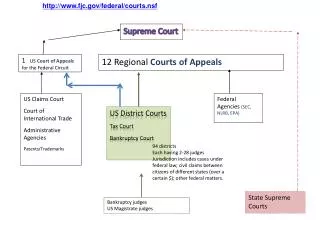
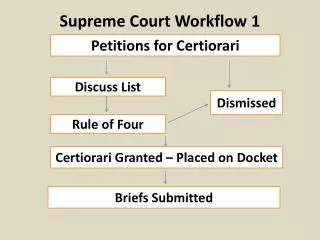
Supreme Court Workflow 1 Petitions for Certiorari Discuss List Dismissed Rule of Four Certiorari Granted – Placed on Docket Briefs Submitted
Supreme Court Workflow 2 Oral Argument Conference/ Opinion Assigned Majority Opinion Circulated Dissents/Concurrences Circulated Opinion Released
Key Terms to Review • Original Jurisdiction • Appellate Jurisdiction • Writ of Mandamus • Judiciary Act of 1789, Section 13 • Art. III, sec. 2 of the Constitution
Questions for Marbury Jurisdiction is the power of a court to hear a case, shouldn’t this have been decided first? Did Congress give the Supreme Court original jurisdiction in Sec. 13 of the Judiciary Act? Does the Constitution give Congress the power to regulate the Supreme Court’s jurisdiction? Who wins in this case? Consider Gibson’s critique of MarburyinEakin. Who has the better argument, Marshall or Gibson?