Download
1 / 26
290 likes | 567 Vues
Explore the dynamic world of fashion with insights on style interpretation, change triggers, consumer acceptance, and taste evolution. Discover the fascinating fashion life cycles, adoption theories, and motives behind consumer buying patterns. Learn about women’s wear categories, men’s styling options, and children’s clothing sizes and price ranges. Uncover the relationship between style, size, and price dynamics in the fashion industry.

E N D
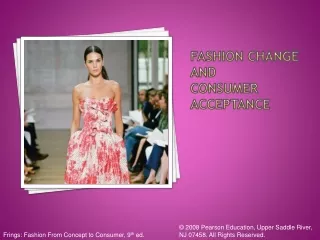
Fashion The style or styles most popular at a given time. Implies: - style - change - acceptance - taste
Style • Interpret fashion ideas into new styles and offer to the public • Designs that have the same characteristics are referred to as a style; may come or go in fashion, but the specific style always remains that style. • Personal style created by wearing clothes suited to oneself
Change • Constant change in fashion • Newness stimulates buying • Changes because • Reflects change in lifestyle and events • People need change • Boredom • Sense of timing is important
Acceptance • Implies consumers must buy and wear a style to make it a fashion • Purchases by a large group of people must occur • Degree of acceptance provides clues to upcoming trends
Taste • Sensitivity to what is beautiful and appropriate • Changes over time
Fashion Evolutions • Introduction of a style • Increase in popularity • Decline in popularity • Rejection of a style or Obsolescence
Fashion Cycle Lengths • Classics • Fads: Short lived fashions • Cycles within cycles: Design elements {color, texture, or silhouette} • Recurring cycles
Fashion Consumer Groups • Fashion Leaders • Fashion Innovators • Fashion Motivators • Fashion Followers • Fashion Victim
Fashion Adoption Theories • The Traditional Theory • Trickle-Down Theory • Based on the traditional process of copying and adapting trendsetting fashion from Paris, Milan, London, and New York designers • Reverse Adoption Theory • Trickle-Up Theory/ Bottom-Up Theory • Designers pay attention to what people are wearing • Mass Dissemination Theory • Trickle-Across Theory • Manufacturers look at celebrities and copy hot new styles instantly to meet customer demands
Motives for consumer buying • To fill an emotional need • To be attractive • To be fashionable • To impress others • To be accepted • To fill basic life-style needs
Consumer Buying Patterns/Shopping Criteria • Perceived value: looking for their idea of quality at reasonable prices • Item buying: buying only one item, to update wardrobe • Multiple use clothing: comfortable, functional, multiple-use • Wear now: buying closer to need, will wear immediately • Convenience • Service: personal service and in-stock assortments
3 Styling Features • Color • Texture • Style
7 Practical Consumer Considerations • Brand/Designer Label • Fabric: Performance and care • Quality and durability • Price • Fit • Comfort • Appropriateness
Women’s Wear Clothing Categories • Dresses • Social Apparel • Suits • Outerwear • Sportswear • Activewear • Swimwear • Lingerie • Accessories
Styling and Price Ranges • Couture/Luxury • Made to order to fit an individual client • $5,000-$50,000 • Designer • Ready-to-wear from successful designers • $1,000-$5,000 • Bridge • Less expensive alternatives to designer fashion • Donna Karan’s DKNY, Marc by Marc Jacobs • Contemporary: • Revived category aimed at style-conscious women who want more fashion than misses style provides • BCBG, Max Studio, Theory • Misses • More conservative adaptations or accepted designer looks • Liz Claiborn, Lauren/Ralph Lauren • Junior • Young styling for a young figure • Resulted from the high birthrate in 1980s
Men’s Clothing Categories • Tailored clothing • Furnishings • Dress shirts, neckwear, underwear, hoisery, robes, pajamas, shoes, and boots • Sportswear • Active Sportswear • windbreakers, ski jackets, joggings suits • Work clothes • Accessories
Men’s Styling • Designer • Traditional Styling • Classic suit and sportswear • Traditional sportswear • Contemporary • Less expensive than designer apparel
Men’s Price Ranges • Custom-tailored • More than $3,000 • Designer ready-made • $500-$1,000 • Bridge suits • Step down in price from designer • Moderate suits • Suits: $325-$650; Jackets $200-$450 • Popularly priced suits • Less than $325
Children’s Wear • Girl’s dresses • Boy’s traditional • Swimwear • Outerwear • Sleepwear • Accessories
Children’s Sizing • Newborn sizes 0-11; 3-6-9 months • Infant sizes 12-18-24 months • Toddler sizes 2T, 3T, 4T • Separation of sizes for boys and girls • Girls 4-6X, preteens 6-14 • Boys 4-7 and 8-20
Price Ranges • Better • Tommy Hilfiger • Moderate • Esprit, Osh Kosh B’Gosh • Budget • Carter’s, Rampage