Understanding Covalent Bonds: Properties and Characteristics of Covalent Compounds
This chapter explores the nature of covalent bonds formed by atoms sharing electrons, adhering to the octet rule. It highlights the interactions between nonmetal atoms, resulting in separate amorphous molecules with no regular shape. Key properties include low density, varying melting and boiling points, and the potential for flammability. Additionally, it distinguishes between polar and nonpolar covalent bonds, examining their electronegativity differences, solubility in solvents, and conductivity when dissolved or melted.

Understanding Covalent Bonds: Properties and Characteristics of Covalent Compounds
E N D
Presentation Transcript
1. 1 Chapter 6-Covalent Bonds Properties of covalent compounds
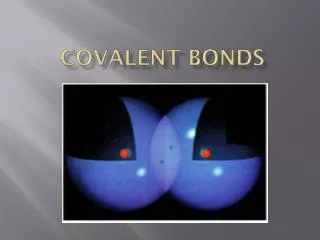
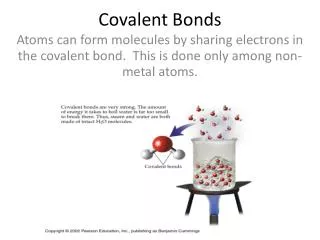
A. Formed by atoms sharing electrons
(still obey octet rule, but both atoms
can count shared electrons as part
of octet)
B. Formed by nonmetal atoms reacting
together-both atoms want to take
electrons
2. 2
C. Form separate molecules
are amorphous-no regular shape
D. Low density, M.P. & B.P.
molecules have spaces between them
many are flammable
E. Can have liquids, gases or solids at
room temperature
(depends on molecule size)
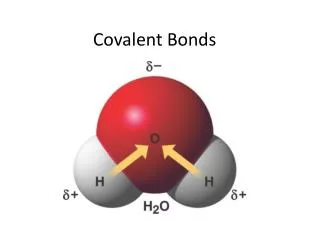
3. 3 F. Two Types of Covalent Bonds Polar Bonds electronegativity difference between 0.4 & 1.7 b. electrons unequally shared pulled to higher electronegativity have small charges on molecules c. are poor conductors if dissolved or melted d. soluble with ionic or polar (like dissolves like-both have charges)