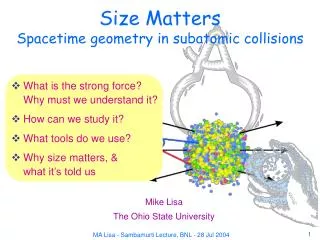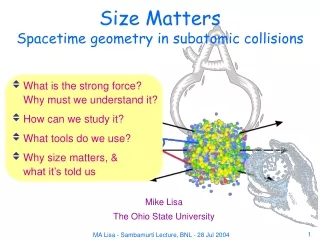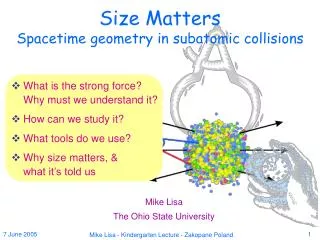
Size Matters Spacetime geometry in subatomic collisions
480 likes | 594 Vues
This lecture delves into the strong force, a fundamental interaction crucial for understanding nuclear structure and behavior. We explore its significance, why we must study it, and the methodologies involved. Essential tools such as the Relativistic Heavy Ion Collider (RHIC) enable the observation of phenomena like quark confinement and the generation of deconfined states. Moreover, we discuss size's role in these subatomic interactions and present insights into Quantum Chromodynamics (QCD) and the phase diagram of matter at extreme conditions, enhancing our understanding of the universe's fundamental forces.


Size Matters Spacetime geometry in subatomic collisions
E N D
Presentation Transcript
What is the strong force?Why must we understand it? • How can we study it? • What tools do we use? • Why size matters, &what it’s told us Size MattersSpacetime geometry in subatomic collisions Mike Lisa The Ohio State University Mike Lisa - Kindergarten Lecture - Zakopane Poland
Forces and structures in Nature • Gravity • one “charge” (mass) • force decreases with distance m1 m2 • 2) Electric (& Magnetic) • two “charges” (+/-) • force decreases with distance Atom + - + + Mike Lisa - Kindergarten Lecture - Zakopane Poland
quark Atomic nuclei and the “nuclear” force • Nuclei composed of: • protons (+ electric charge) • neutrons (no electric charge) • Does not blow up!? “nuclear force” • overcomes electrical repulsion • determines nuclear reactions(stellar burning, bombs…) • arises from fundamental strong force (#3) • acts on color charge of quarks neutron proton Mike Lisa - Kindergarten Lecture - Zakopane Poland
To understand the strong force and the phenomenon of confinement: Create and study a system of deconfined colored quarks (and gluons) quark-antiquark pair created from vacuum An analogy… and a difference! to study structure of an atom… electron …separate constituents Imagine our understanding of atoms or QED if we could not isolate charged objects!! nucleus neutral atom Confinement: fundamental & crucial (but not understood!) feature of strong force - colored objects (quarks) have energy in normal vacuum quark Strong color field Energy grows with separation !!! “white” 0 (confined quarks) E=mc2 ! “white” proton (confined quarks) “white” proton Mike Lisa - Kindergarten Lecture - Zakopane Poland
Generating a deconfined state • Present understanding of Quantum Chromodynamics (QCD) • heating • compression • deconfined color matter ! Hadronic Matter (confined) Nuclear Matter (confined) Quark Gluon Plasma deconfined ! Mike Lisa - Kindergarten Lecture - Zakopane Poland
Expectations from Lattice QCD /T4 ~ # degrees of freedom confined: few d.o.f. deconfined: many d.o.f. TC ≈ 173 MeV ≈ 21012 K ≈ 130,000T[Sun’s core] Mike Lisa - Kindergarten Lecture - Zakopane Poland
The phase diagram of QCD Early universe quark-gluon plasma critical point ? Tc Temperature colour superconductor hadron gas nucleon gas nuclei CFL r0 Neutron stars vacuum baryon density Mike Lisa - Kindergarten Lecture - Zakopane Poland
The phase diagram of water • Analogous graphs • superfluids • superconductors • metal/insulator • … Mike Lisa - Kindergarten Lecture - Zakopane Poland
Bulk Matter • We must create/compress/heat a bulk (geometrically large) system • freeze/melt a single H20 molecule? • fundamental distinction from particle physics • Only achievable through collisions of the heaviest nuclei (Au, Pb) at the highest available energy– at RelativisticHeavy Ion Collider (RHIC) 1000’s of particles produced in each collision Mike Lisa - Kindergarten Lecture - Zakopane Poland
PHOBOS BRAHMS RHIC PHENIX STAR AGS TANDEMS Relativistic Heavy Ion Collider (RHIC) 1 km v = 0.99995c = 186,000 miles/sec Mike Lisa - Kindergarten Lecture - Zakopane Poland
PHOBOS BRAHMS RHIC PHENIX STAR AGS TANDEMS STAR ~500 Collaborators Relativistic Heavy Ion Collider (RHIC) Mike Lisa - Kindergarten Lecture - Zakopane Poland
Solenoidal Tracker At RHIC goal: track “all” charged hadrons (bags of quarks) emitted in each collision The STAR Experiment • STAR: Solenoidal Tracker at RHIC • multipurpose detector system for hadronic measurements • large coverage (geometrical acceptance) • tracking of charged particles in high multiplicity environment • measure correlations of observables • study of hard processes (jet physics) Mike Lisa - Kindergarten Lecture - Zakopane Poland
Operation of a Time Projection Chamber Electric field ..generating a cluster of liberated electrons Anode wires with +HV sitting ~5 mm above pads Copper pads ~ 1cm2 “Avalanche” as electrons approach anode wire... V ADC t Amplifying and digitizing electronics connected to each pad bucket # Charged particle flies thru TPC gas… DAQ SCA/ADC ..capacitively inducing a signal on nearby pads... ..which is amplified, digitized, and recorded for later analysis Mike Lisa - Kindergarten Lecture - Zakopane Poland
One collision seen by STAR TPC Momentum determined by track curvature in magnetic field… …and by direction relative to beam Mike Lisa - Kindergarten Lecture - Zakopane Poland
“RHIC is big” • big facility • big detectors • big collaborations • “big” collisions as seen by the Landsat-4 satellite… Mike Lisa - Kindergarten Lecture - Zakopane Poland
10-18 10-12 10-6 100 106 1012 1018 1024 “Big” and “Small” – in meters 1,000,000,000,000,000,000,000,000 m 0.000000000000000001 m Mike Lisa - Kindergarten Lecture - Zakopane Poland
10-24 10-18 10-12 10-6 100 106 1012 1018 1024 Today’s lecture “Short” and “long” – in seconds as many yoctoseconds (10-24 s ~ 3 fm/c) in a second as seconds in 10 thousand trillion years Mike Lisa - Kindergarten Lecture - Zakopane Poland
Particle momentum from tracking… … how to get particle space-time information?? Mike Lisa - Kindergarten Lecture - Zakopane Poland
b = 0 “central collision” many particles produced “peripheral collision” fewer particles produced Impact parameter & Reaction plane Mike Lisa - Kindergarten Lecture - Zakopane Poland
b = 0 “central collision” many particles produced “peripheral collision” fewer particles produced Impact parameter & Reaction plane Mike Lisa - Kindergarten Lecture - Zakopane Poland
How do semi-central collisions evolve? 1) Superposition of independent p+p: momenta pointed at random relative to reaction plane Mike Lisa - Kindergarten Lecture - Zakopane Poland
How do semi-central collisions evolve? 1) Superposition of independent p+p: high density / pressure at center momenta pointed at random relative to reaction plane 2) Evolution as a bulksystem Pressure gradients (larger in-plane) push bulk “out” “flow” “zero” pressure in surrounding vacuum more, faster particles seen in-plane Mike Lisa - Kindergarten Lecture - Zakopane Poland
N N 0 0 /4 /4 /2 /2 3/4 3/4 -RP (rad) -RP (rad) How do semi-central collisions evolve? 1) Superposition of independent p+p: momenta pointed at random relative to reaction plane 2) Evolution as a bulksystem Pressure gradients (larger in-plane) push bulk “out” “flow” more, faster particles seen in-plane Mike Lisa - Kindergarten Lecture - Zakopane Poland
Azimuthal distributions at RHIC STAR, PRL90 032301 (2003) b ≈ 6.5 fm b ≈ 4 fm “central” collisions midcentral collisions Mike Lisa - Kindergarten Lecture - Zakopane Poland
Azimuthal distributions at RHIC STAR, PRL90 032301 (2003) b ≈ 10 fm b ≈ 6.5 fm b ≈ 4 fm peripheral collisions Mike Lisa - Kindergarten Lecture - Zakopane Poland
“v2” Elliptic flow – collectivity& sensitivity to early system • “Elliptic flow” • evidence ofcollective motion • quantified by v2 • geometrical anisotropy momentum anisotropy • sensitive to early pressure • evidence for • early thermalization • QGP in early stage STAR, PRL90 032301 (2003) Hydrodynamic calculation of system evolution Mike Lisa - Kindergarten Lecture - Zakopane Poland
A more direct handle? • elliptic flow (v2) and other measurements (not discussed) evidence towards QGP at RHIC • indirect connection to geometry • Are there more direct handles on the space-time geometry of collisions? • yes ! Even at the 10-15 m / 10-23 s scale ! • What can they tell us about the QGP and system evolution? Warning: some quantum mechanics coming (feel free to concentrate on “bottom line”) ! ! Mike Lisa - Kindergarten Lecture - Zakopane Poland
The Bottom line… if a pion is emitted, it is more likely to emit another pionwith very similar momentumif the source is small Creation probability r(x,p) = U*U F.T. of pion source Measurable! probingsource geometry through interferometry p1 r1 x1 p source r(x) 1 m x2 r2 p2 experimentally measuring this enhanced probability: quite challenging 5 fm Mike Lisa - Kindergarten Lecture - Zakopane Poland
Au+Au R ~ 6 fm p+p R ~ 1 fm d+Au R ~ 2 fm Correlation functions for different colliding systems STAR preliminary C2(Qinv) Qinv (GeV/c) Different colliding systems studied at RHIC Interferometry probes the smallest scales ever measured ! Mike Lisa - Kindergarten Lecture - Zakopane Poland
p1 Rlong q Rside p2 Rout beam direction More detailed geometry Relative momentum between pions is a vector can extract 3D shape information Rlong – along beam direction Rout – along “line of sight” Rside – “line of sight” Mike Lisa - Kindergarten Lecture - Zakopane Poland
small RSIDE RSIDE big RSIDE 0 /4 /2 3/4 -RP (rad) Source shape • “observe” the source from all angles relative to the reaction plane • expect oscillations in radii for non-round sources reaction plane Mike Lisa - Kindergarten Lecture - Zakopane Poland
central collisions mid-central collisions peripheral collisions Measured final source shape STAR, PRL93 012301 (2004) Expected evolution: ? Mike Lisa - Kindergarten Lecture - Zakopane Poland
p1 p2 More information Relative momentum between pions is a vector can extract 3D shape information Rlong – along beam direction Rout – along “line of sight” Rside – “line of sight” Rout Rside study as K grows… Mike Lisa - Kindergarten Lecture - Zakopane Poland
Why do the radii fallwith increasing momentum ?? Mike Lisa - Kindergarten Lecture - Zakopane Poland
Why do the radii fallwith increasing momentum ?? It’s collective flow !! Directgeometrical/dynamicalevidence for bulk behaviour!!! Amount of flow consistent with p-space Mike Lisa - Kindergarten Lecture - Zakopane Poland
Timescales • Evolution of source shape • suggests system lifetime is shorter than otherwise-successful theory predicts • Is there a more direct handle on timescales? Mike Lisa - Kindergarten Lecture - Zakopane Poland
p1 q p2 Disintegration timescale Relative momentum between pions is a vector can extract 3D shape information Rlong – along beam direction Rout – along “line of sight” increases with emission timescale Rside – “line of sight” Rout Rside Mike Lisa - Kindergarten Lecture - Zakopane Poland
Disintegration timescale - expectation 3D 1-fluid Hydrodynamics Rischke & Gyulassy, NPA 608, 479 (1996) with transition with transition “” “” • Long-standing favorite signature of QGP: • increase in , ROUT/RSIDE due to deconfinement confinement transition • expected to “turn on” as QGP energy threshold is reached Mike Lisa - Kindergarten Lecture - Zakopane Poland
8 8 6 6 RO (fm) 4 4 RS (fm) 1.5 1.25 RO / RS 1.0 increasing collision energy Disintegration timescale - observation • no threshold effect seen • RO/RS ~ 1 RHIC Mike Lisa - Kindergarten Lecture - Zakopane Poland
Disintegration timescale - observation • no threshold effect seen • RO/RS ~ 1 • toy model calculations suggest very short timescales Mike Lisa - Kindergarten Lecture - Zakopane Poland
Heinz & Kolb, hep-ph/0204061 An important space-time “puzzle” at RHIC - actively under study Disintegration timescale - observation • no threshold effect seen • RO/RS ~ 1 • toy model calculations suggest very short timescales • rapid, explosive evolution • too explosive for “real” modelswhich explain all other data N() Mike Lisa - Kindergarten Lecture - Zakopane Poland
Summary • Crucial feature of strong force: confinement • study bulk system of deconfined quarks • bulk systemis created in heavy ion collisions at RHIC ! • geometric (v2) and other measurements strongly suggest bulk deconfined matter ! • We can access the smallest size and time scales through quantum-mechanical mechanism of interferometry • close investigation of space-time: our understanding of the hot, dense system evolution is incomplete • Focusing on holes in understanding-- key to scientific progress • these are exciting times in our study of the least well-understood force in Nature … and clearly size matters in this quest ! Mike Lisa - Kindergarten Lecture - Zakopane Poland
Heinz & Kolb, hep-ph/0204061 An important space-time “puzzle” at RHIC - actively under study Disintegration timescale - observation • no threshold effect seen • RO/RS ~ 1 • toy model calculations suggest very short timescales • rapid, explosive evolution • too explosive for “real” modelswhich explain all other data N() Mike Lisa - Kindergarten Lecture - Zakopane Poland
PHENIX ~ 500 collaborators PHOBOS BRAHMS RHIC PHENIX STAR AGS TANDEMS Relativistic Heavy Ion Collider (RHIC) Mike Lisa - Kindergarten Lecture - Zakopane Poland
To understand the strong force and the phenomenon of confinement: Create and study a system of deconfined colored quarks (and gluons) quark-antiquark pair created from vacuum An analogy… and a difference! to study structure of an atom… electron …separate constituents Imagine our understanding of atoms or QED if we could not isolate charged objects!! nucleus neutral atom Confinement: fundamental & crucial (but not understood!) feature of strong force - colored objects (quarks) have energy in normal vacuum quark Strong color field Energy grows with separation !!! “white” 0 (confined quarks) E=mc2 ! “white” proton (confined quarks) “white” proton Mike Lisa - Kindergarten Lecture - Zakopane Poland
To understand the strong force and the phenomenon of confinement: Create and study a system of deconfined colored quarks (and gluons) quark-antiquark pair created from vacuum An analogy… and a difference! to study structure of an atom… electron …separate constituents Imagine our understanding of atoms or QED if we could not isolate charged objects!! nucleus neutral atom Confinement: fundamental & crucial (but not understood!) feature of strong force - colored objects (quarks) have energy in normal vacuum quark Strong color field Energy grows with separation !!! “white” 0 (confined quarks) E=mc2 ! “white” proton (confined quarks) “white” proton Mike Lisa - Kindergarten Lecture - Zakopane Poland
Disclaimer many of the concepts I will present are “works in very active progress” an unavoidable consequence of exciting, cutting edge science Mike Lisa - Kindergarten Lecture - Zakopane Poland