Understanding Stars: Composition, Distance, and Classification
350 likes | 488 Vues
Explore the fascinating characteristics of stars, including their composition, distance from Earth, and classification. Discover that stars are self-luminous balls of hot gas composed mainly of hydrogen and helium, with varying colors, sizes, and temperatures. Learn how distance is measured in light years and how apparent and absolute magnitudes help us understand their brightness. Delve into spectroscopic analysis and the Doppler effect to uncover the motion of stars and their spectral classifications based on temperature. Join us in understanding the life cycle of stars through the Hertzsprung-Russell diagram.


Understanding Stars: Composition, Distance, and Classification
E N D
Presentation Transcript
STARS 101 Chapter 30
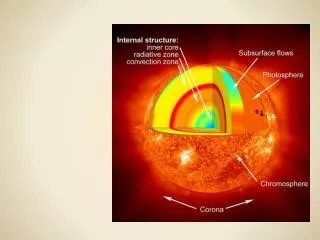
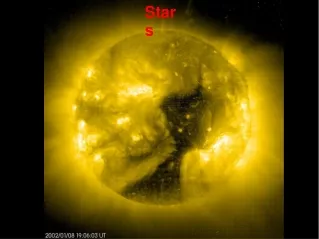
What is a Star? • a self-luminous ball of hot gas that generates its own energy
Stars vary in : • COLOR • SIZE • MASS • COMPOSITION • TEMPERATURE • DISTANCE FROM EARTH • BRIGHTNESS
Stars are composed of the same elements found on Earth: • Hydrogen (most common element) • Helium (second) • Carbon • Nitrogen • Calcium
Temperature is indicated by Color • BLUE Stars 35,000°C-50,000°C • YELLOW Stars 5,000°C • RED Stars 3,000°C
Distance to Stars • Measured in light years • The distance light travels in one year • Light moves at 300,000 km/sec 186,000 miles/sec
What does this mean? • The sun is 93 million miles away or 8 light minutes • Light from the sun reaches us in 8 minutes • The closest star is Proxima Centauri, over 4.2 light years away • Sirius is 9 light years away • Polaris is 700 light years away
ONE LIGHT YEAR- • 9.5 trillion km • 5.865 trillion miles
STELLAR MAGNITUDES • APPARENT- how bright a star seems from Earth • ABSOLUTE- how bright the stars would seem if they were all set at the same distance its TRUE brightness
APPARENT MAGNITUDE • The brightest stars have the lowest numbers • The dimmest stars have the highest numbers • The faintest star visible with the naked eye is ranked a 6 on the apparent magnitude scale. • Sirius is ranked a -1.46 • The sun has an apparent magnitude of -26.8
ABSOLUTE MAGNITUDE • Imagines all stars set at 32.6 light years from Earth • Scale ranges from -5 to +15 • The Sun is ranked +5
Spectral Analysis of Stars Astronomers learn about stars by analyzing their LIGHT SPECTROGRAPHS (define – use p 775) Separate light into colors / wavelengths SPECTRUM( define use p 775) Reveals the star’s composition and temperature
MOTION OF STARS • APPARENT- due to mvt of Earth • A) move west (counterclockwise) due to rotation • B) shift to west a little earlier each night due to earth’s revolution
Motions of Stars (continued) • ACTUAL • 1- rotate on their axis • 2-may revolve around another star • 3-move toward or away from the Solar System
DOPPLEREFFECT- shifting of wavelengths of light toward the RED end of the spectrum as an object moves away from the observer
How do astronomers measure distance? • PARALLAX-the apparent shift in position of a star (object) when viewed from a different angle • The closer a nearby star- the greater the shift • The farther away a star is , the less it will shift • Try it:
Demonstrating Parallax Raise your finger to your nose and view a nearby object. Blink your eyes alternately. Now move your finger a little further away and blink again. The shift is less than before.
Spectral Classification of Stars Astronomers group stars by their surface temperature Use letters : O B A F G K M Hottest coolest O Be A Fine Girl Kiss Me ! See reference table 1.1
Spectral Classification continued 10 Sub categories : by number (0 to 9) For ex : an M2 star is hotter than an M7 star Our Sun is a G 2 star Betelgeuse is an M 2
Luminosity Another way to classify stars By width of spectral lines Uses Roman numeral I,II,III,IV,V Betelgeuse is an M2 I star See reference table 1.2
Hertzsprung-Russell Diagram • A pattern revealed by plotting the temperature vs. the absolute magnitude of stars • Shows that brightness increases as temperature increases • Reveals “life cycle” of most stars