Understanding Domestic Violence: Power, Control, and Reporting Requirements
250 likes | 356 Vues
Domestic violence affects individuals of all genders and sexual orientations, with 95% of cases involving men abusing women. This societal issue is characterized by power and control, leading to a cycle of violence that impacts families and communities. Registered nurses are mandated to report any suspected abuse to authorities, with strict consequences for failure to do so. This guide outlines the characteristics of abusers and victims, the cycle of violence, and necessary steps for professionals in healthcare to ensure they effectively support those affected by domestic violence and child maltreatment.


Understanding Domestic Violence: Power, Control, and Reporting Requirements
E N D
Presentation Transcript
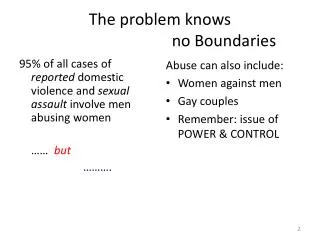
The problem knows no Boundaries 95% of all cases of reported domestic violence and sexual assault involve men abusing women …… but ………. Abuse can also include: • Women against men • Gay couples • Remember: issue of POWER & CONTROL
Societal Problem • Economics – increased use of healthcare system. • Increased incidence of child maltreatment in homes with IPV; • Furthers the cycle of violence; increased incidence of criminal behavior.
Reporting Requirements (general abuse mandate) Registered nurses are mandated to report known or observed instances of abuse to the appropriate authorities • Professional capacity/within scope of employment • Failure to report is considered “unprofessional conduct” [by BRN] and can lead to disciplinary action against license • Failure to comply is a misdemeanor, punishable by up to 6 months in jail, a fine of $1000 or both
Reporting Laws (1) General Abuse: CPC 11160 • Provider of medical services for a physical condition that they know or reasonably suspect is the result of assaultive or abusive conduct • Includes “adults, children, & others, (including spouses)” • Report the incident to local law enforcement immediately or as soon as practically possible • Prepare & send a written report tolocal law enforcementlwithin2 working days
Reporting Laws (obj. 1) Child Abuse-[CPC 11166] • Knowledge • Observation • Reasonable suspicion …that a child is the victim of child abuse • Report to CPS immediately or as soon as practically possible by phone • Prepare & send a written report to CPS within 36 hours of receiving the information about the incident
The Face of the Victim • stress in household • Abused as a child • Married at a young age • self esteem • Helplessness or perceived helplessness • Financial dependence • Pregnancy a dangerous time
Characteristics of the Abuser • Abused or witnessed abuse as a child • Abuse of ETOH or drugs • Controlling behaviors • Pathologic jealousy • Verbal abuse physical abuse over time
The Abuser • Use of isolation, intimidation, threats • Extreme jealousy or possessiveness • Controls access to $$$ & transportation • Low tolerance for frustration • Poor impulse control • Little insight into own behavior • Blames victim for the behavior
Cycle of ViolenceWalker, Lenore (1979), The Battered woman. • Tension building • hostile behaviors • use of alcohol, drugs • Victim tries to stay out of the way; placates • Battering Incident • Abuser explodes into violence • Hit • Burn • Beat • Rape • Victim is powerless • Victim endures until incident runs its course, usually 2-24 hours • Self-esteem
Cycle of Violence Honeymoon Phase • Abuser remorseful • Abuser makes promises • Victim wants to believe
Physical Evidence • Symmetrical bruises on upper arms, wrists, neck • Nail marks or swatch of hair missing from head • Black eyes, fx mandible, • Lacerations around eyes & lips • Subdural hematomas • Rib fx • Bruises on breasts & genitalia • No single sign • Subtle signs • Injuries that do not match the stated mechanism • History of frequent admissions/ visits to health care provider
High Index of Suspicion • Abused watches partner for approval before answering • Abused edges to side of bed when abuser comes near • Abused heart rate increases when abuser comes near • Abusers refuse to allow a male nurse to care for partner • Abusers refuse to allow partner alone with caregivers • Abusers refuse to leave the room
Further Assessment • Nurse must be alone with the patient when questions are asked • Asking when abuser is in the room may trigger a battering incident!! • Open the subject as a routine • FUND* recommendations: • All females > age 14, regardless of sx of violence. • *Family Violence Prevention Fund
CDC “RADAR” screening guideline • R-routinely screen every patient • A-ask directly, kindly, w/o judgment • D-document findings • A-assess patient's safety • R-review options and provide referrals
Assessment Tools PVS – Partner Violence Screen • Have you ever been hit, kicked, punched or otherwise hurt by someone in the past year? • Do you feel safe in your current relationship? • Does a partner from a previous relationship make you feel unsafe now? • Benefits of Screening:
Safety-Promoting Behaviors • Hide money, house key, car key • Code w/family or friends • Remove weapons • SSN • Birth certificates • Bank account numbers • Hidden bag w/extra clothing • Rent/utility receipts • McFarlane, J. et al (2004), “Increasing the Safety-Promoting Behaviors of Abused Women”, AJN, 104(3) 40-50.
Child Maltreatment Child abuse is defined in the California State Penal Code to include: • intentional physical injury to a child less than 18 years of age, inflicted by another • sexual abuse • neglect • permitting to be or willfully endangering the person or health of a child • unjustifiable physical pain or mental suffering • unlawful corporal punishment • abuse or neglect in out-of-home care
Children who grow up with violence: • learn that violence is an acceptable way to relieve stress, get what they want, and interact with the world and the people they love. • They then incorporate these attitudes and values into their relationships as they grow up. (Childabuse.stanford.edu)
Parental Characteristics (obj.2) • Childhood punishment was seen as unfair and severe • Relationship with parents was negative • Has difficulty controlling aggressive impulses • Free expression of violence is consistent • Socially isolated • Fewer support systems • Teenaged mothers • Low self esteem
Child Characteristics (obj. 2) “fit” between child’s temperament and parent’s ability to deal with that behavioral style • Illegitimate • Unwanted • Brain damaged • Physically disabled • Hyperactive • Reminder • Prematurity • Difficult labor & delivery • Multiple births
Environmental Characteristics • Chronic stress • Divorce • Poverty • Poor housing • Frequent relocation • Alcoholism • Drug addiction • All social strata • Poverty predisposes but …. • Concealed crises in wealthy families
Clinical Tipoffs • Serious injury – no hx of trauma • History inconsistent with severity of injury • Delay in seeking care for significant injury • History that changes during eval • Recurrent injuries w/poor explanation
Talking with children • Private place • Do not promise not to tell • Required by law • Do not express shock or criticize family • Use their vocabulary • Avoid leading statements that can distort their report • Reassure them that they have done the right thing by telling • Abuse is not their fault • Determine immediate need for safety • Prepare child about next steps
Denial of Child Abuse • The abuser, noninvolved parent, and child may deny the abuse • Each may deny • The event • Awareness of the event • The impact of the event • Responsibility for the event