Understanding Attitudes: Components, Foundations, and Influences on Behavior
This overview explores the significance and components of attitudes, including beliefs, affect, and behavioral intentions. It highlights the characteristics of attitudes such as favorability, accessibility, and confidence, and discusses how attitudes are formed based on cognitive and affective foundations. The text delves into expectancy-value models, attitude change strategies, and the role of advertising in shaping beliefs. Additionally, it examines the influences on cognitively and affectively based attitudes and the relationship between attitudes and behavior, particularly in varying levels of involvement.

Understanding Attitudes: Components, Foundations, and Influences on Behavior
E N D
Presentation Transcript
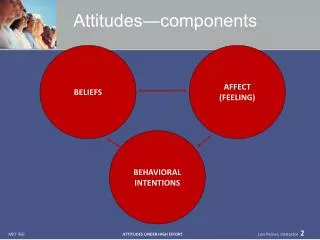
Attitudes―components BELIEFS AFFECT (FEELING) BEHAVIORAL INTENTIONS
Significance of Attitudes • Cognitive: Guide thinking • Affective: Influence feelings • Connative: Impact behavior
Characteristics/Dimensions of Attitudes • Favorability—Positive or negative • Accessibility—How easily the attitude is retrieved • May require thinking or evaluation • Ultimate result may be either highly positive or highly negative or in between • Confidence—Certainty with which the attitude is held • Persistence—Extent to which the attitude will remain accessible and relevant over time • Resistance to change—Extent to which new information is likely to change the attitude • Ambivalence—Difficulty in balancing competing positive or negative aspects
Foundations of Attitudes • Based on cognition (thoughts at various levels of consciousness) or affect (emotion) or some combination
Cognitive Foundations of Attitudes • Direct or imagined experience • Reasoning by analogy or category • Values driven attitudes • Social identity generated attitudes • Analytical processes • Responses • Counter arguments • Support arguments • Source derogation • Belief discrepancy: More counterarguments are likely to be generated to a message with which one disagrees
Expectancy Value Models • Theory of Reasoned Action (TORA)
Some Attitude Change Strategies • Change beliefs—usually very difficult • Strengthen positive beliefs • Weaken negative beliefs • Change evaluations of consequences • Add new belief • Encourage attitude formation based on imagined experience • Target normative beliefs (need to consider reactance)
Generating Beliefs Through Advertising • Statements must be • Perceived • Comprehended • Remembered • Believed (at least in part)
Adding Beliefs (True or Not): Examples • Brushing and flossing do not reach all areas of the mouth • People under stress need more vitamins • Baking soda will reduce odor of refrigerators • Fragmented hard drives may cause computer errors
Positioning Through Creating Beliefs • “It’s not delivery; it’s De Journo!” • “Wal-Mart. Always low prices. Always.” • “I just saved a bunch of money on my auto insurance.” • “U-um Good!” (Campbell’s Soup)
Multiattribute Models of Attitude • Attitude computed as a function of multiple attributes weighted for importance: Ab= attitude toward brand b Wi: weight of attribute I Xib: belief about brand b’s performance on attribute I • Model assumes rationality Calculations will not be required on the exam. You should know conceptually what this involves conceptually—i.e., weighing importance and intensity of feeling.
Influences on Cognitively Based Attitudes • Communications source • Source credibility • Trustworthiness • Expertise • Status • Company reputation • Message • Argument quality • One-sided vs. two-sided messages • Comparative messages
Affective Foundations of Advertising • Engagement: Extent of personal connection to brand or object • Regulatory (goal) fit • Promotion focus • Prevention focus • Affective responses (generations of feelings and images) • Culture—appeal to ego vs. group oriented • Negative emotions may be more powerful
Influences on Affect Based Attitudes • Source • Attractiveness • Match-up Hypothesis: Attractiveness is more effective when consistent with the product category • Message • Emotional appeals and contagion • Shame and guilt associations may not be effective • Disgust unintentionally induced (e.g., through humor) tends to have a negative impact • Discomfort with ambivalence
Fear Appeal • Complicated to implement • Self-defense mechanism may kick in • Certain appeals that evoke guilt or regret may work • Optimal level of stimulus intensity • Offering a solution to overcome featured outcome
Attitude Toward the Ad • Liking of ad may lead to liking of product • Generally used for low involvement product categories (e.g., batteries) • In higher involvement contexts: • Informative advertisements • Hedonic: Enjoyable advertisements
Attitudes and Behavior • Greater consistency under • High level of involvement and elaboration • Attitude confidence • Specificity of attitude • Emotional attachment • Attitude accessibility • Some modifiers • Situational influences • Normative factors • Personality • High vs. low self-monitors