Download
1 / 18
180 likes | 319 Vues
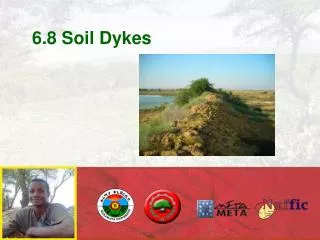
This guide explores the construction and maintenance of soil dykes, focusing on their role in diverting water in river systems. It covers different types of dykes, such as diversion and guide dykes, detailing construction techniques, material selection, and maintenance practices to ensure their longevity and effectiveness. Key aspects include site selection, soil composition, and reinforcement methods. The guide emphasizes the importance of managing flood channels to prevent breaches, especially during high-water events, while also suggesting additional techniques for lowland applications.

E N D
SOIL DYKES: MOST COMMON WAY OF DIVERTING WATER • Diversion cum guide dykes: • In upper part of river, where slope is higher, water force is higher and there are mainly gravel and coarse sand deposits Crossdykes cum guide dykes: • In lower part of the river, more gentle slopes, sandy-loamy deposits, water velocity is less, can breach during high floods
SOIL DYKES: DIMENSIONS OF SAD/GANDIS IN DI KHAN IMPORTANT TO INCLUDE THE GUIDEDYKE ALONG THE FLOOD CHANNEL TOO!! Source: Khan and Marwat, 2004
Construction soil dykes: using bulldozers or..
Using bullocks with scraperboards Local organisation
Constructing soil dykes • Location: • Determined by lay of the land • Manage water levels and avoid overflow/ flooding • In case of cross dyke - preferably at angle, try to dissipate energy • In case of cross dyke -may have upstream offtakes too • Construction • Look for good loamy soil – avoid gravel and sand • Avoid saline soil and do rat control – to prevent piping • Develop layer by layer • Compaction with bulldozer driving across the dyke • Protect against animal tresspassing • Protect with some vegetation and brushwood • Generally crest 0.6-0.9 meter above the level of the flood channel • Special issue • Often flood channels are not well maintained and silted up causing pressure on the soil dykes – that may break too soon
Soil dykes break: • In case of high floods or: • If the flood channels cannot remove all flood water in time • Or on purpose if the entire area is served and/or water has to be passed downstream
SOIL DYKES: MAINTENANCE Source: Khan and Marwat, 2004
Reinforcing earthen dykes: Gabions
Reinforcing earthen dykes:plastic sheeting Material Black polyethelene plastic 150-250 micron Cost 0.35 USD/m2 Construction Avoid puncture Use steps to contruct to Avoid slippage Anchor at toe and head Cover with 50 cm soil
DISCUSSION: SCOPE FOR SUCH SYSTEMS IN LOWLANDS OF ETHIOPIA?
POTENTIAL TO BE EXPLORED..... Convert natural drains in flood channels Pre-irrigate and store moisture Protect vegetation on river banks Use diversion cum guide soil dykes