Understanding Future Interests in Real Property: Remainders and Their Variants
This document comprehensively explores the concept of future interests in real property, particularly focusing on remainders. It defines various types of remainders, including Vested Remainders (Indefeasibly Vested, Subject to Partial Divestment, and Subject to Total Divestment), along with Contingent Remainders. The legal principles, such as the Rule in Shelly’s Case and the Doctrine of Worthier Title, are explained through illustrative examples. This guide serves as a vital resource for understanding both the foundational and nuanced elements of property law regarding future interests.

Understanding Future Interests in Real Property: Remainders and Their Variants
E N D
Presentation Transcript
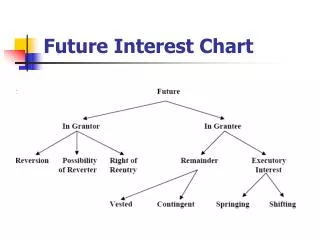
Remainders • Held by a third person (not the grantor) • Created by the same instrument (deed or will) as the possessory interest • Becomes possessory immediately upon the expiration of the prior estate (no gaps) • Does not divest or shorten a prior estate; the prior estate must end naturally
Vested Remainder • Owner is born and ascertained • Interest is not subject to condition precedent
Indefeasibly Vested Remainder “To A for life, then to B and her heirs.”
Vested Subject to Partial Divestment (Open) • Remainder limited to a class of which there is at least one living member. • “To A for life, then to B’s children and their heirs” assuming (1) B has at least one child at the time of the conveyance and (2) B is still alive (could have more children).
Vested Subject to Total Divestment • Vested remainder (either of the other two types) which is subject to a condition subsequent. • “To A for life, then to B and her heirs, but if B predeceases A, then to C and his heirs.”
Contingent Remainder • Holder is unborn or unascertained. or • A condition precedent must occur before the holder of the interest actually has the possibility of obtaining possession.
Contingent Remainder – unborn scenario “To A for life, then to B’s children and their heirs” assuming (1) B has no children and (2) B is still alive.
Contingent Remainder – unascertained scenario “To A for life, then to B’s heirs” assuming B is still alive.
Contingent Remainder – subject to condition precedent scenario “To A for life, then to B and her heirs if B marries before A’s death” assuming B is still unmarried. Grantor will retain a reversion because condition might not occur.
Kost v. Foster • Astoria Township -- NE 1/2 of Section 7, East 3/8 of S 1/2 of NW 1/2 of said Section 7, T3N R1E
Destructibility of Contingent Remainders • What if the contingency could still happen after the prior estate ends? • “To A for life, remainder to B and her heirs if B marries X” – A could die with both B and X surviving but not yet married. • To A for life, then to B and his heirs if B attains age 21” – A could die with while B is still alive but under age 21
Rule in Shelly’s Case • Grantee has a freehold interest in real property, and • Heirs of grantee have a remainder interest in same property.
Rule in Shelly’s Case • “To A for life, then to A’s heirs.”
Rule in Shelly’s Case • “To A for life and then to A’s heirs if A graduates from the Texas Tech University School of Law.”
Rule in Shelly’s Case • “To A for life and then to A’s children and their heirs.”
Doctrine of Worthier Title • Future interest transferred inter vivos to heirs of the grantor
Doctrine of Worthier Title • “To A for life and then to my heirs.”
Doctrine of Worthier Title • “To A and his heirs until A gets married, then to my heirs.”