Understanding Inosilicates: Pyroxenes and Amphiboles in Geology
Inosilicates are a class of silicate minerals characterized by their chain-like structures. Two notable groups within this category include pyroxenes (single chains) and amphiboles (double chains). Pyroxenes, commonly found in mid-ocean ridge basalt (MORB), display a general formula of XYZ2O6 with Z cations primarily being silicon. Amphiboles, more prevalent on continents due to weathering, reveal various structural and compositional differences that influence their properties. This guide explores their classification, crystallography, and geological significance.

Understanding Inosilicates: Pyroxenes and Amphiboles in Geology
E N D
Presentation Transcript
Inosilicates (chain) • Common Fe/Mg – bearing silicates • Two common groups • Pyroxenes: single chains • Amphiboles: double chains • Pyroxenes are common in MORB • Amphiboles more common on continents because of weathering
Pyroxene group • General formula: XYZ2O6 • Z/O ratio = 1/3 • Z cations usually Si, occasionally Al • Single chain extend along c axis • Chains are stacked along a axis, alternating: • Base faces base • Apex faces apex
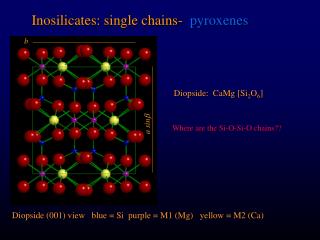
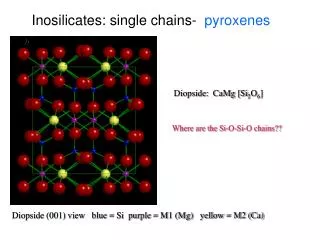
View down c axis View down a axis Fig. 14-1 Two distinct sites, depending on location relative to chains M1 and M2 Base facing base Apex facing Apex
X cations in M2 sites • Between bases of tetrahedrons • Distorted 6- and 8- fold coordination • Depends on stacking and the size of the cations • Y cations in M1 sites • 6-fold coordination between apical oxygen
“I-beams” • Consist of two chains connected by Y cations • Located in M1 sites • Closeness of apical oxygen and 6-fold coordination make bonds strong Apex pointed at apex I-beam
I-beams held together by X cations in M2 site • Coordination number depends on how chains line up • 6-fold coordination gives orthorhombic symmetry - OPX • 8-fold coordination gives monoclinic symmetry - CPX
Crystallographic and optical axes align C crystallographic axis at 32 to 42º angle to the Z optical axis Pigeonite – CPX - Monoclinic OPX - Orthorhombic
Crystal shapes • Blocky prisms, nearly square • Elongate along c axis • Cleavage controlled by I-beams • Cleavage typically between 87º and 93º • Only when viewed down the c axis • Mineral grain must be cut parallel to (001)
Fig. 14-1 I beams – tightly bonded Weak zones between faces of I beams Weak planes between “I beams” = cleavage Cleavage angles are 87º and 93º
Classification • Based on two linked things • Which cations occurs in M2 sites (facing bases of tetrahedron) • Cation determines symmetry • Most plot on ternary diagram with apices: • Wollastonite, Wo • Enstatite, En • Ferrosilite, Fe
Three major groups • Orthopyroxenes (opx) – orthorhombic • Low-Ca clinopyroxenes (cpx) – monoclinic • Ca-rich clinopyroxenes (cpx) – monoclinic • The amount of Ca in the mineral controls the extinction angle
Orthopyroxenes: Fe and Mg, but little Ca • Both M1 and M2 are octahedral • Larger Fe ion more concentrated in M2 site (larger)
Low-Ca clinopyroxene: more Ca, but no solid solution with Hi-Ca clinopyroxene • Mineral species is Pigeonite • Ca restricted to M2 sites, these still mostly Fe and Mg • M1 sites all Mg and Fe
Ca- clinopyroxene • Diopside Mg(+Ca) to Hedenbergite Fe (+Ca) • M2 site contains mostly Ca • M1 site contains mostly Fe and Mg • Most common specie is augite • Al substitutes in M1 site, and for Si in tetrahedral site • Na, Fe or Mg substitutes for Ca in M2 site
Other common pyroxenes • Jadeite NaAlSi2O6 • Spodumene LiAlSi2O6
Possible ranges of solid solutions Fig. 14-2 “Augite” Clinopyroxene Orthopyroxenes Na – bearing pyroxenes
Identification in hand-sample difficult • Mostly based on occurrence • Also color can be indicative • Optical properties distinguish clino- from ortho-pyroxenes • If composition is important, need chemical analysis
Geology of pyroxenes • Igneous • Common igneous pyroxenes: augite, pigeonite, and opx • Augite most common • Usually in mafic and intermediate volcanics • Both intrusive and extrusive • Zoning common: magma becomes enriched in Fe because of partition of Mg into crystals • Requires 3 component phase diagram • Exsolution common – cooling allows rearrangement of Ca
Exsolution mechanisms • Augite original crystallization • Ca substitution in M2 sites restricted • As cools, Ca reorganizes • Generally find exsolution lamellae of pigeonite (low Ca cpx) within host augite parallel to (001) or opx parallel to (100) Augite Matrix
Opx crystallize at high T with excess Ca – up to 10% • Slow cooling allows Ca expelled to form exsolution of augite (hi-Ca cpx) • Single lamellae of augite parallel to (100) • Bushveld variety – S. Africa type location Opx Matrix
Pigeonite grows in mafic magma • Up to 10% Ca in M2 site • Cooling causes Ca to expel and form augite (hi-Ca cpx) lamellae • Single lamellae parallel to (001) Pigeonite Matrix
If slow enough pigeonite converts to opx • Pigeonite only preserved where cooling fast (volcanic) • Slow cooling creates second set augite (hi-Ca cpx) parallel to (100) • “Stillwater type” Opx Matrix
Metamorphic • Carbonate rocks, typically diopside because of Ca and Mg from calcite and dolomite • Amphibolite common association (water) • Na and Ca clinopyroxenes • Typically restricted to high T and low P conditions • Found at subduction zones (blue schist facies)
Opx also in granulite facies rocks • Hot enough to remove water • Derived from amphiboles
Sedimentary • Not stable (anhydrous) • Converts to clay minerals
Amphibole Group • Structure, composition, and classification similar to pyroxenes • Primary difference is they are double chains • Z/O ratio is 4/11
Structure • Chains extend parallel to c axis • Stacked in alternating fashion like pyroxenes • Points face points and bases face bases
Shared O Fig. 14-12 • Chains are linked by sheets of octahedral sites • Three unique sites: M1, M2, and M3 • Depend on location relative to Si tetrahedron Not shared O OH
TOT layers • Two T layers (tetrahedral layers with Z ions) • Intervening O layer (octahedron) with M1, M2, and M3 sites • Form “I-beams” similar to pyroxenes
Geometry produces five different structure sites • M1, M2, and M3 between points of chains • M4 and A sites between bases of chains
Bonds at M4 and A sites weaker than bonds within “I-beams” • Cleavage forms along the weak bonds • “I-beams” wider than pyroxenes • Cleavage angles around 56º and 124º Weak planes between “I beams” = cleavage
CompositionW0-1X2Y5Z8O22(OH)2 • Each cation fits a particular site • W cation • Occurs in A site • Has ~10 fold coordination • Generally large, usually Na+
W0-1X2Y5Z8O22(OH)2 • X cations • Located in M4 sites • Analogous to M2 sites in pyroxenes • Have 6 or 8 fold coordination depending on arrangement of chains • If 8-fold, X usually Ca • If 6-fold, X usually Fe or Mg
W0-1X2Y5Z8O22(OH)2 • Y cations • Located in M1, M2, and M3 sites; Octahedral cations in TOT strips • Usually Mg, Fe2+, Fe3+, Al • Z cations • Usually Si and Al
Composition • Most common amphiboles shown on ternary diagram • Wide variety of substitution, simple and coupled • Divided into ortho and clino amphiboles • Depends on X cations in M4 site (largely amount of Ca), distorts structure • Reduces symmetry from orthorhombic to monoclinic
W0-1X2Y5Z8O22(OH)2 Fig. 14-13 Tremolite Ferroactinolite ~30% Ca exactly 2/7 of sites available for Ca Grunerite Monoclinic Anthophylite Orthorhomic
Identification • Hand sample and thin section difficult • Best method is association • Ca and Na amphiboles commonly dark green to black, pleochroic: usually Hornblende • White or pale green amphiboles usually called tremolite
Geology of amphiboles • Several important aspects • Hydrous – water part of their structure • Not stable in anhydrous environments • Dehydrate at high temperature • High Z/O ratio (4/11) mean they should occur in Si-rich rocks
Generalization • Not common in mafic and ultramafic rocks • Crystallize late in magmatic history; melt rich in Si and H2O • Overgrowths of amphibole on pyroxenes common • Common in felsic to intermediate rocks • Fe and Mg minerals either amphibole or biotite • Depends on abundance of K (biotite) and Ca/Na (amphiboles) • Generally amphibole tends toward intermediate rocks; biotite toward felsic
Amphiboles common in regional metamorphism of intermediate to mafic rocks • Usually water rich from breakdown of clay and micas • Metamorphic rock with abundant amphiboles called amphibolitefacies • At high T, amphiboles break down to pyroxenes Note – these generalities are likely to be wrong
Pyroxenoid Group • Similar to pyroxenes • Single chains • Z/O ratio 1/3 • Differ in repeat distance along c axis • Pyroxene – 2 tetrahedron repeat (5.2 Å) • Pyroxenoid – 3 or more repeat (more than 7.3 Å) • Difference is the pyroxenes are straight pyroxenoids are kinked • Cased by larger linking cations
Pyroxenes Rhodenite - Mn Wollastonite - Ca
Only a few minerals • Most common Wollastonite – Ca • Others are Rhodonite – Mn • Pectolite – Ca and Na
Wollastonite • Composition: Ca with some Mn and Fe substitution • Common in altered carbonate rocks, particularly with reaction with qtz • Useful industrial mineral, replacing asbestose, also used in paints and plastics