
SlideServe
Menu
Préférences
© SlideServe · v2026

Tides

menora avatar
9 diapositives · 299 Views · Aug 07, 2014

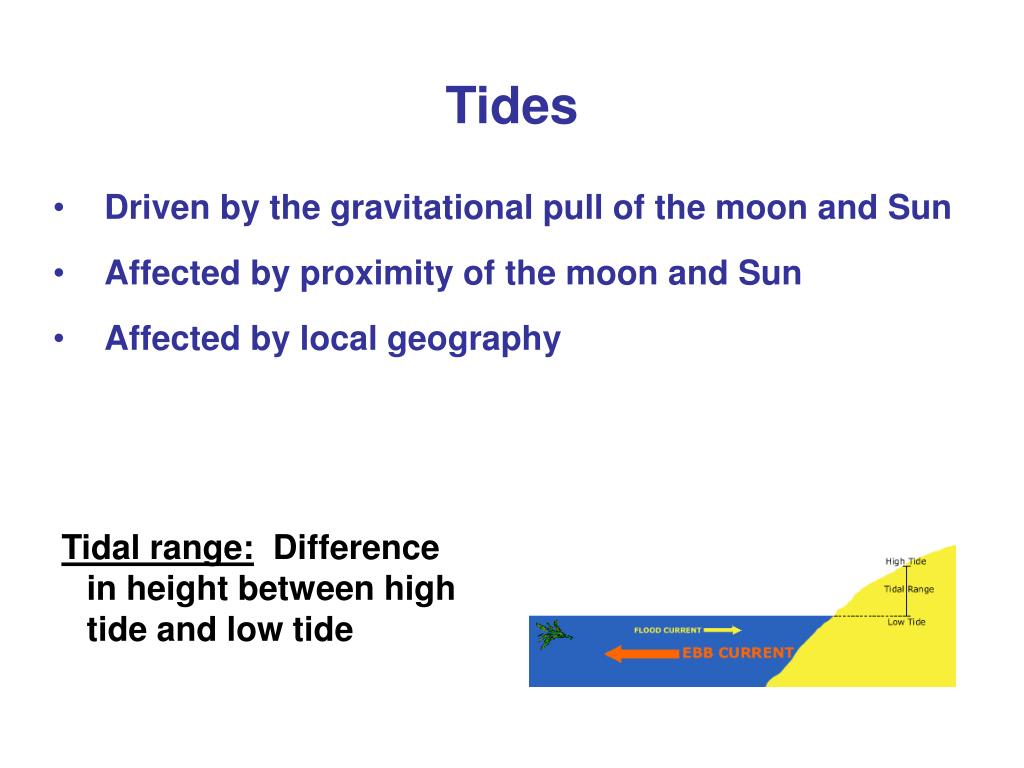
Tides. Driven by the gravitational pull of the moon and Sun Affected by proximity of the moon and Sun Affected by local geography. Tidal range: Difference in height between high tide and low tide. Why does the moon have a greater effect than the Sun?.
Tides - slide 1
01 / 9Tides
1 / 17

Télécharger la présentation

Tides
Une image / un lien ci-dessous est fourni (tel quel) pour télécharger la présentation

Politique de téléchargement : le contenu du site vous est fourni TEL QUEL pour votre information et votre usage personnel ; il ne peut être vendu, concédé sous licence ni partagé sur d’autres sites sans l’accord de son auteur.Le contenu vous est fourni TEL QUEL, pour votre information et votre usage personnel uniquement. Téléchargez la présentation en cliquant sur ce lien. Lors du téléchargement, si vous ne parvenez pas à télécharger une présentation, l’éditeur a peut-être supprimé le fichier de son serveur.Pendant le téléchargement, si vous ne parvenez pas à obtenir une présentation, le fichier a peut-être été supprimé par l’éditeur.

F I N

Plus de contenu associé

Transcription de la présentation
  1. Tides • Driven by the gravitational pull of the moon and Sun • Affected by proximity of the moon and Sun • Affected by local geography Tidal range: Difference in height between high tide and low tide

  2. Why does the moon have a greater effect than the Sun? • Newton’s law of universal gravitation: • The gravitational attraction between two bodies is: • directly proportional to their masses • inversely proportional to the square of the distance between the bodies

  3. Spring tides and neap tides

  4. Tides & proximity to Earth For the strongest tides, where would the Sun, moon, and Earth be?

  5. Lunar day = 24 h., 50 m

  6. Coriolis effect • due to shape and rotation of the Earth • true for objects moving over the Earth (e.g. air, water, planes, projectiles) • objects moving in the Northern Hemisphere are diverted to the RIGHT • objects moving in the Southern Hemisphere are diverted to the LEFT

  7. Coriolis effect examples Coriolis cannon game http://www.eoascientific.com/campus/earth/multimedia/coriolis/view_interactive Coriolis – plane flight examples http://www.classzone.com/books/earth_science/terc/content/visualizations/es1904/es1904page01.cfm?chapter_no=19 Merry-go-round video http://ww2010.atmos.uiuc.edu/(Gh)/guides/mtr/fw/crls.rxml More simulations http://www.physics.orst.edu/~mcintyre/coriolis/

  8. Discuss with your group Based on the Coriolis effect, how do you think the freshwater from the Delaware River and the seawater from the ocean will move as they flow in and out of the river with the tides? (drawing this may help)