Ground Motion Modeling: Parameters, Variability, and Site Classification for Seismic Analysis
This document outlines the critical aspects of ground motion modeling, including median and standard deviation considerations. It discusses essential ground motion parameters such as peak ground acceleration (PGA), peak ground velocity (PGV), and pseudo-spectral acceleration at 5% damping for various magnitudes (5.0-8.5) and distances (0-200 km). The significance of site classification and its implications for seismic hazard assessments, along with key issues like aleatory variability and oversaturation effects, are explored. Recent model changes, including parameter dependencies related to fault types and soil characteristics, are also examined.

Ground Motion Modeling: Parameters, Variability, and Site Classification for Seismic Analysis
E N D
Presentation Transcript
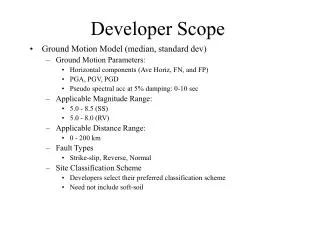
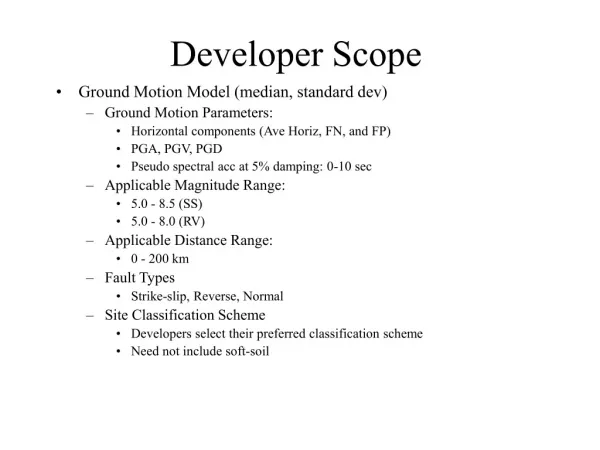
Developer Scope • Ground Motion Model (median, standard dev) • Ground Motion Parameters: • Horizontal components (Ave Horiz, FN, and FP) • PGA, PGV, PGD • Pseudo spectral acc at 5% damping: 0-10 sec • Applicable Magnitude Range: • 5.0 - 8.5 (SS) • 5.0 - 8.0 (RV) • Applicable Distance Range: • 0 - 200 km • Fault Types • Strike-slip, Reverse, Normal • Site Classification Scheme • Developers select their preferred classification scheme • Need not include soft-soil
Key Issues • Oversaturation • Is it due to the aspect ratio, or the magnitude? • Use of Aspect ratio • Are aspect ratios used in NGA consistent with aspect ratios currently used in hazard analyses? • Correlation with style-of-faulting • Dependence on dip • Is this dip effects or a regional effect?
Key Changes from Previous Models • Site classification • Vs30 • Depth of soil term (Z1.0 or Z1.5) • Source • Oversaturation with magnitude • Aspect ratio as a key parameter • Non-linear site response • Based on median rock PGA including event term
T=1 sec Vs=600 C&Y w/o AR
T=1 sec SS Vs=600 C&B w/o AR
T=1 sec SS Vs=600 A&S AR<=2
T=1 sec SS Vs=600 A&S
PGA Hazard Vs=600 Site near Hayward Fault (2 km)
T=1 sec Hazard Vs=600 Site near Hayward Fault (2 km)
PGA Hazard Vs=600 Site near San Andreas Fault (2 km)
T=1 Sec, Hazard Vs=600 Site near San Andreas Fault (2 km)