The Quakers
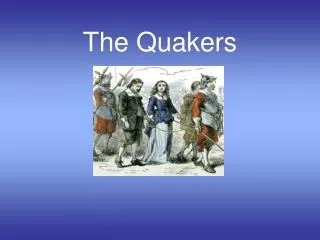
The Quakers. Quakers in 17th Century England. Origins - A nonconformist movement What did they believe? Simplicity Inner revelation Pacifism Practices. The Peace Testimony. Also known as the Testimony Against War What was it? Where was it derived from? Significance?.

The Quakers
E N D
Presentation Transcript
Quakers in 17th Century England • Origins - A nonconformist movement • What did they believe? • Simplicity • Inner revelation • Pacifism • Practices
The Peace Testimony • Also known as the Testimony Against War • What was it? • Where was it derived from? • Significance?
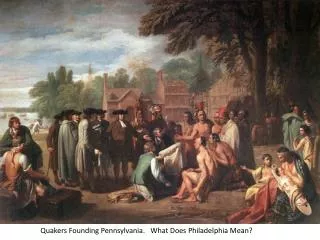
Quakersin Pennsylvania Penn’s ideal • A pacifist state • A model for the world • A precedent: “All things have their beginnings.” • Colonial response • Persecution, imprisonment, & execution
The ‘holy experiment’ Quakers in government • Control of the Assembly • Independence • Successful economy • Western frontiersmen • Tensions
Quakers & Indians Relations with the native Americans • Friendly relations • European & Indians conflicts • Preaching • Increasing atrocities
The failure of the ‘peaceable kingdom’ Why did it fail? • Voted out of govt • Divisions within the ‘peaceable kingdom’ • Penn’s absence • Failure to convert Indians and most European colonists • Self-enclosed community • Demands of empire • A small nonviolent island in a sea of brutal colonial rule • Persecution
BACKGROUND: Born 1720 Literary works - Journal now considered a classic of English literature Employment Minister - 1743 JOHN WOOLMAN
BELIEFS‘The gentle conscience of Quakerism’ • Evils of slavery: • Exploitation of labour and oppression of poor • He believed in the equality of humanity • Inconsistent with the Christian religion • Good in all others • Return to a simple lifestyle - wealth and greed as unnecessary evils
NONVIOLENT ACTION‘conduct is more convincing than language’ 1.) Tax Refusal: • 1755 - refusal to pay military tax • 1761 - journey to native colony during time of war 2.) Anti-slavery measures: • Journeys throughout colonies - quiet testimony • Insisted on payment of slaves • Did not push guilt onto slave owners • Argued from Quaker tradition and scripture • The TRUTH was all important 3.) Other Actions: • 1772 - walking tour protest in England • Adopted a plain lifestyle • A model of selfless devotion
IMPORTANCE TO THE HISTORY OF NONVIOLENT RESISTANCE • 1776 - Quakers adopted a policy of abolition of slavery • Introduced the idea of DIALOGUE • ‘Passive Obedience’ • Symbolic actions ‘The most significant figure in the early history of non-violence in the North American colonies’ (LYND)