Unlocking Advanced Level of Detail Techniques for Game Development**
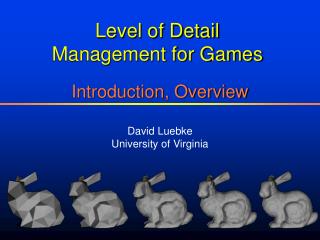
Dive into the intricacies of Level of Detail (LOD) methods essential for modern game development. This course is designed for game developers seeking to refine their skills in managing 3D scene complexity and optimizing performance across various platforms. Building upon foundational LOD concepts, participants will explore advanced topics such as generating LOD frameworks, balancing fidelity, and runtime management. Engage with expert speakers from leading universities and Pixar Animation Studios, and gain practical insights into applying LOD in real game settings. Join us to elevate your understanding of LOD in gaming.

Unlocking Advanced Level of Detail Techniques for Game Development**
E N D
Presentation Transcript
Course Introduction • Level of detail (LOD) methods are a crucial tool for game developers • Manage complexity of 3D scenes • Trade off fidelity for performance • Tune game for different platforms • This course will cover advanced issues in LOD for games
Course Prerequisites • We assume • Knowledge of the basic LOD concept • Experience with interactive graphics • Target audience: game developers wishing to • become sophisticated LOD users • write or modify code to create LODs • gain a broader perspective on the LOD field
Course Topics • Generation LOD frameworks & creation • Application Applying LOD in the game setting • Theory Measuring & controlling fidelity
SpeakersIn Order of Appearance • David Luebke, University of Virginia • Amitabh Varshney, University of Maryland • Jon Cohen, Johns Hopkins University • Martin Reddy, Pixar Animation Studios • Ben Watson, Northwestern University • Rob Huebner, Nihilistic Software
Course History • Courses at IEEE VR and SIGGRAPH • Book – Level of Detail for 3D Graphics • Coupon • Tried to distill a • Practical overview for game developers • Useful introduction to relevant theory • Introduction to potentially useful academic research
Course Schedule 10 Luebke Welcome, Introductions 10:15 Varshney Generating LODs: Algorithms Operators and algorithms for simplification 11 Break 11:15 CohenGenerating LODs: Error Measuring error to guide simplification & LOD 12 Reddy Runtime LOD Management Balancing cost, benefit, and rendering budget 12 :30 Lunch
Course Schedule 2 Watson Generating LODs: Topics Artist-assisted and out-of-core simplification 3 Luebke, View-Dependent LOD Varshney Higher fidelity per polygon…at a cost 4 Break 4:15 Reddy Terrain Simplification Algorithms for an important special case 5 Huebner Game LOD: Geometric LOD Platform challenges, LOD in game production 5:30 Huebner Game LOD: Beyond Geometry Textured imposters, shader LOD, and more
LOD Course notes • Some slides are available on GDC CD • All slides will be available at lodbook.com • Web site for our book • “Level of Detail for 3D Graphics” • 20% coupon available from speakers • Lots of other info available at the web site! • Publicly available LOD source code • Links to commercial tools, sample models • Full bibliography
Level of Detail: The Basic Idea • In its most common form: • Simplify the amount of detail used to render small or distant objects • Known as Level of Detailor LOD • A.k.a. polygonal simplification, geometric simplification, mesh reduction, decimation, multiresolution modeling, …
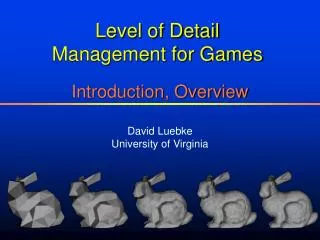
Level of Detail:Traditional Approach • Createlevels of detail (LODs) of objects: 69,451 polys 2,502 polys 251 polys 76 polys Courtesy Stanford 3D Scanning Repository
Level of Detail:Traditional Approach • Distant objects use coarser LODs:
Discrete Level of Detail • Traditional LOD in a nutshell: • Create LODs for each object separately, using artists or a software preprocess • At run-time, pick each object’s LOD according to object distance or similar criterion • Other approaches are possible • Continuous LOD, view-dependent LOD, terrain LOD, imposters, shader LOD, etc. • We will discuss these throughout the tutorial
Next: Generating LODs • Next topics: • Amitabh will discuss algorithms and operators for creating simple LODs from complex models • Jon will discuss error metrics to guide and evaluate LOD creation