Understanding Prokaryotes: Eubacteria and Archaebacteria
Learn about the classification, identification, movement types, metabolic diversity, and importance of prokaryotes including Eubacteria and Archaebacteria. Discover their shapes, cell walls, growth, and reproduction processes.


Understanding Prokaryotes: Eubacteria and Archaebacteria
E N D
Presentation Transcript
Bacteria19-1 BIO 1004 Flora
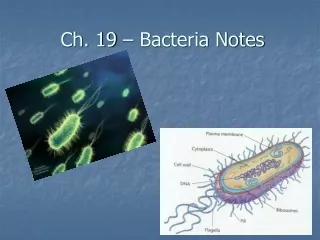
Classifying Prokaryotes • 2 Categories • _________________ • _________________ • Eubacteria • Larger of the 2 kingdoms • Live anywhere • Surrounded by _____________ • Contain peptoglycan (___________________) • Protects from injury • Inside cell wall is cell membrane • Some of these bacteria have a second membrane • Makes it resistant to damage
Cont. Types • Archaebacteria • Look similar to eubacteria, but differ chemically • Lack _________________ and also have different membrane lipids • DNA is more like eukaryotes • Live in harsh environments
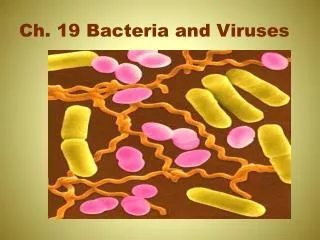
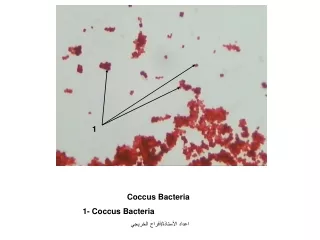
ID of Prokaryotes • Shape • Rod Shaped – bacilli • Spherical – ________ • Spiral -spirilla • Cell Walls • Gram staining is used to determine what type (how many) of cell wall the bacteria has (2 or 1)
ID of Prokaryotes Cont. • Cell Walls Cont. • Gram positive – thick peptoglycan and retain __________ color • Gram negative – much thinner walls and ____________ color Types of movement - snake, whip, glide, or no movement
Metabolic Diversity • Heterotrophs (2 types) • Chemoheterotrophs – must take in organic molecules for energy and carbon supply • _________________– use sunlight for energy, but also need to take in organic molecules • Autotrophs • Photoautotrophs – use sunlight to make carbon compounds from __________ • Live in deep ocean
Releasing Energy • Obligate aerobes – organisms that require oxygen • Obligate anaerobes – do not require oxygen • Soil bacteria – clostridium botulinum • __________ anaerobes – survive with or without oxygen • Can live anywhere
Growth and Reproduction • 3 Types • Binary Fission – replicates DNA and divides in half • asexual • Conjugation – hollow bridge forms between bacterial cells • ________ and _________ move from one cell to the other • Increases genetic diversity • Spore formation • Occurs when reproduction is unfavorable • ________________ – DNA enclosed in thick walls • Can remain dormant for years
Importance of Bacteria • Decomposers • Nitrogen fixation • Importance in humans • Digestion • E. coli