Area Calculation of Kites and Trapezoids: Practice Problems and Solutions
This resource provides a step-by-step guide on calculating the area of kites and trapezoids using provided formulas and examples. It illustrates how to derive the lengths of diagonals and apply the area formulas with real-world applications, such as finding the area of a city park represented on a grid. Detailed practice problems challenge learners to compute areas using given coordinates and dimensions, enhancing their understanding of geometry in a practical context.

Area Calculation of Kites and Trapezoids: Practice Problems and Solutions
E N D
Presentation Transcript
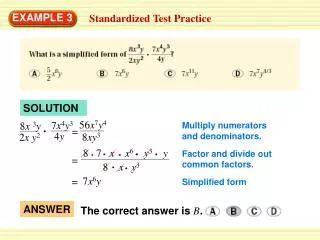
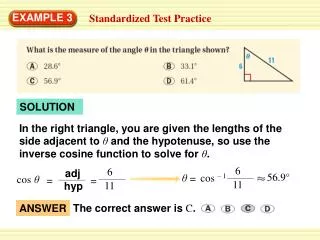
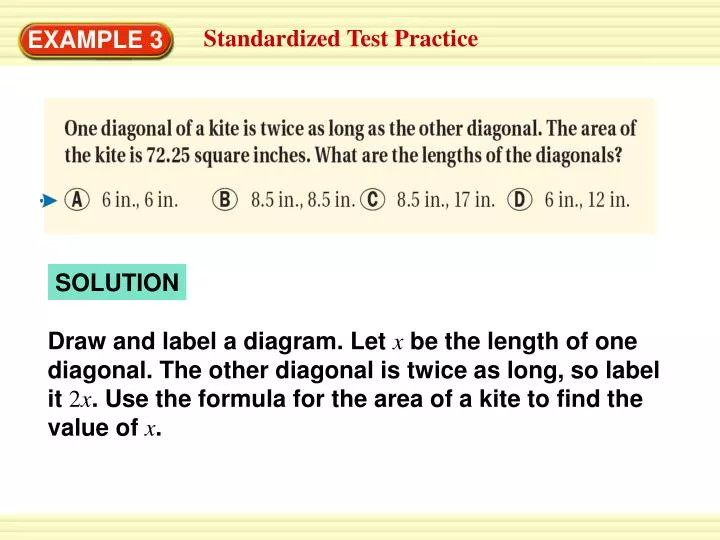
Standardized Test Practice EXAMPLE 3 SOLUTION Draw and label a diagram. Let xbe the length of one diagonal. The other diagonal is twice as long, so label it 2x. Use the formula for the area of a kite to find the value of x.
1 A = d1d2 2 1 72.25 = (x)(2x) 2 Standardized Test Practice EXAMPLE 3 Formula for area of a kite Substitute72.25for A, xfor d1, and2xford2.
ANSWER The correct answer is C. Standardized Test Practice EXAMPLE 3 72.25 = x2 Simplify. 8.5 = x Find the positive square root of each side. The lengths of the diagonals are8.5 inches and 2(8.5) = 17 inches.
You have a map of a city park. Each grid square represents a 10 meter by 10 meter square. Find the area of the park. Find an area in the coordinate plane EXAMPLE 4 City Planning
b1 = BC = 70 – 30 b2 = AD = 80 – 10 h = BE = 60 – 10 Find an area in the coordinate plane EXAMPLE 4 SOLUTION STEP 1 Find the lengths of the bases and the height of trapezoid ABCD. = 40 m = 70 m = 50 m
1 1 A = h(b1 + b2) = (50)(40 + 70) 2 2 ANSWER The area of the park is 2750square meters. Find an area in the coordinate plane EXAMPLE 4 STEP 2 Find the area of ABCD. = 2750
ANSWER d1 = 2 √10 ft, d2 = 8 √10 ft for Examples 3 and 4 GUIDED PRACTICE 4. The area of a kite is 80square feet. One diagonal is 4 times as long as the other. Find the diagonal lengths.
ANSWER 16units2 for Examples 3 and 4 GUIDED PRACTICE 5. Find the area of a rhombus with vertices M(1, 3), N(5, 5), P(9, 3), andQ(5, 1).