Agentic AI vs GenAI Key Features, Uses, and Differences_Credo Systemz
0 likes | 3 Vues
https://www.credosystemz.com/courses/agentic-ai-course/<br><br>At Credo Systemz, we combine expert-led training with hands-on projects to make you industry-ready in Agentic AI. Our approach ensures you not only understand the theory but also gain practical skills that employers value.


Agentic AI vs GenAI Key Features, Uses, and Differences_Credo Systemz
E N D
Presentation Transcript
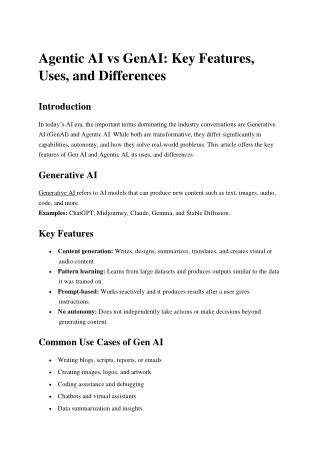
Agentic AI vs GenAI: Key Features, Uses, and Differences Introduction In today’s AI era, the important terms dominating the industry conversations are Generative AI (GenAI) and Agentic AI. While both are transformative, they differ significantly in capabilities, autonomy, and how they solve real-world problems. This article offers the key features of Gen AI and Agentic AI, its uses, and differences. Generative AI Generative AI refers to AI models that can produce new content such as text, images, audio, code, and more. Examples: ChatGPT, Midjourney, Claude, Gemma, and Stable Diffusion. Key Features Content generation: Writes, designs, summarizes, translates, and creates visual or audio content. Pattern learning: Learns from large datasets and produces outputs similar to the data it was trained on. Prompt-based: Works reactively and it produces results after a user gives instructions. No autonomy: Does not independently take actions or make decisions beyond generating content. Common Use Cases of Gen AI Writing blogs, scripts, reports, or emails Creating images, logos, and artwork Coding assistance and debugging Chatbots and virtual assistants Data summarization and insights
Agentic AI Agentic AI goes beyond content generation and it is referred to as autonomous AI agents. They can plan, reason, make decisions, and take actions without continuous human input. These systems combine AI + automation + reasoning + tools to complete complex tasks from start to finish. Key Features Autonomy: Can work independently to achieve goals. Multi-step reasoning: Breaks a task into smaller steps and executes them intelligently. Tool usage: Can operate APIs, browse the internet, run scripts, or control systems. Memory + learning: Improves performance and adapts to conditions over time. Proactive behavior:Doesn’t just answer questions—takes initiative to complete objectives. Common Use Cases of Agentic AI Automated customer support agents AI DevOps agents that deploy, test, or monitor applications AI research assistants that gather data, compare sources, and generate reports Sales agents that send emails, schedule demos, and update CRM AI personal assistants that plan tasks, set reminders, and perform online actions Autonomous cybersecurity monitoring Key Differences Between Agentic AI and GenAI Feature / Aspect GenAI Agentic AI Primary Purpose Create content Execute tasks autonomously Working Style Reactive (responds to prompts) Proactive (takes decisions and actions) Planning, reasoning, action-taking, tool execution Capabilities Text, image, audio generation Autonomy Level Low High
Complex Tasks Needs guidance Can complete end-to-end workflows Memory & Learning Limited context Long-term memory + dynamic adaptation AutoGPT, Devin AI, OpenAI Agents, LangChain Agents Examples ChatGPT, Gemini, Midjourney Why Agentic AI Is the Future While GenAI revolutionized creativity and productivity, the next leap is automation. Agentic AI brings self-directed problem solving, allowing businesses to reduce manual tasks, cut operational costs, and accelerate delivery pipelines. Examples of real-world applications: IT Operations: Automated root-cause analysis, ticket resolution, and monitoring Marketing: Multi-channel campaigns executed end-to-end Data Engineering: Autonomous pipelines that clean, transform, and validate data Software Development: Agents that generate code, test, fix errors, and deploy This shift moves AI from a tool to a collaborative digital worker.