Mastering Kinematics: A Fun Guide to the SUVAT Equations
290 likes | 431 Vues
Dive into the exciting world of kinematics with our catchy guide on the SUVAT equations! This fun rap covers everything you need to know about displacement, velocity, acceleration, and time—parameters that are fundamental in understanding motion. With clear explanations and memorable formulas like ( v = u + at ) and ( S = ut + frac{1}{2}at^2 ), you’ll be able to solve problems with ease. Embrace the mechanics behind mega-parsec galaxies and nanobot movements as you learn kinematics in an engaging way!


Mastering Kinematics: A Fun Guide to the SUVAT Equations
E N D
Presentation Transcript
S, u, v, a, t That this is mighty handy, it’s our S, u, v, a, t
Mega-parsec galaxies and nanobot mechanics All obey the rules of the “Suvat” kinematics
S S is for displacement, distance with direction
S a a is for acceleration, symbol-word connection
S , u, v, a u and v: velocity; at the start and at the end
S , u, v, a, t And t is for the time elapsed I hope you comprehend
v a Vel (m/s) 1 u S t Time (s) There are four equations stemming from a handy chart
v a Vel (m/s) 1 u S t Time (s) And two simple rules that in form five you should have learned by heart
v a Vel (m/s) 1 u S t Time (s) The chart is a generic graph of velocity and time
v a Vel (m/s) 1 u S t Time (s) “a” is the slope and S the area underneath the line
Now if “a” is the slope And on this we all agree
v = u + at Then v will equal u plus the extra a times t
v = u + at And if you square this formula, the answer you can guess
v2 = u2 + 2aS Is v squared equals u squared plus the extra 2aS
v a Vel (m/s) 1 u S t Time (s) Displacement is the area that’s underneath the line
1 v a Vel (m/s) vav u S S t Time (s) And therefore av’rage speed multiplied by elapsed time
S = 1/2.t.(u+v) Displacement, S, is equal to a half t (u plus v)
But displacement can be looked at from another sort of angle
1 v a Vel (m/s) u S t Time (s) The area under is a block plus the top triangle
S = ut + 1/2at2 S will equal ut plus the term half a t squared*
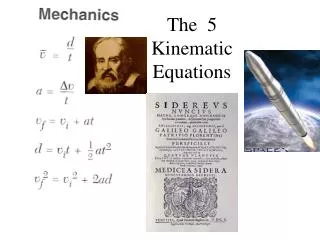
v = u + at v2 = u2 + 2aS S = 1/2.t.(u+v) S = ut + 1/2at2 So there it is and there they are, the handy four equations
v = u + at v2 = u2 + 2aS S = 1/2.t.(u+v) S = ut + 1/2at2 And you can choose the best one for all the situations
a is constant When acceleration’s even. Yes, you can be quite emphatic
v = u + at v2 = u2 + 2aS S = 1/2.t.(u+v) S = ut + 1/2at2 You’ve got your head around these four equations kinematic!