Understanding Characterization: Types and Dynamics in Fictional Characters
Characterization is the process authors use to create and develop fictional characters. Major characters, who drive the conflict, can be dynamic (changing) or static (unchanging). Characters are further classified as round, featuring complex personalities like Hester Prynne from "The Scarlet Letter," or as flat, constructed around a single characteristic. Stereotypes embody conventional traits and can reflect societal truths. Additionally, symbolic figures represent broader themes, illustrated by Iago in "Othello" personifying pure evil. Understanding these elements enhances our appreciation of fiction.

Understanding Characterization: Types and Dynamics in Fictional Characters
E N D
Presentation Transcript
CHARACTERIZATION ANALYSIS
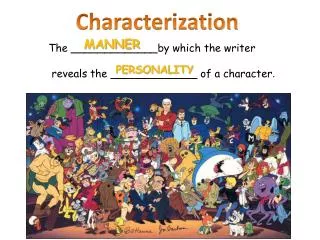
Characterization • Defined: The process by which an author fashions fictional characters. • Major characters are the principal figures. They are the protagonists in regard to conflict. • When a major character changes he is DYNAMIC or KINETIC. • If a character remains the same throughout, we consider him STATIC.
CHARACTERIZATION • Some characters are classified as ROUND • Such characters are complex. Ex – Hester Prynne in The Scarlett Letter is a “round” character in that the reader is allowed to see many facets of her personality. She is human – neither totally good nor bad. • She is motivated by passion and demonstrates an admirable sense of loyalty towards her paramour by keeping his name a secret while at the same time revealing a vulnerability in terms of her qualifications as a mother
… • Other characters are FLAT. These fictional beings are constructed around one central idea or characteristic and never change or surprise the reader • A STEREOTYPE is a conventional character representing a particular group, class, or occupation. This character acts according to patterns. His appearance is familiar, speech predictable, and actions standardized
… • There are as many stereotypes as there are groups: The ragpicker, doorman, salesman, politician, “typical” Texan, senior citizen, slow but good-hearted worker, miser, power hungry individual, stubborn person, etc. • Stereotypes often seem true to experience, not because they are exact replicas of people who walk the streets but because people whom we meet show some of the same traits
… • Symbolic figures: The seven deadly sins for example: pride, gluttony, envy, avarice, lechery, idleness, and wrath are presented as characters, but they truly represent the negative aspect of human behavior. • A character is not symbolic unless he symbolizes something. Ultimately, a symbolic figure is one whose accumulated actions lead the reader to see him as something more than his own person
… • In Othello, Iago is symbolic of pure evil. • Given a protagonist, the conflict of a story may depend on the existence of an antagonist – two equally opposing forces. An antagonist may be human, environmental, physical, mental, or emotional