Factors Driving the Demand for Continuing Professional Education (CPE) in Complex Environments
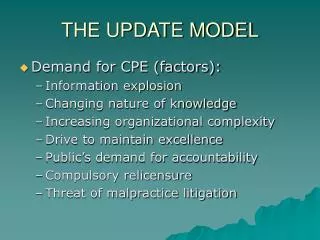
The demand for Continuing Professional Education (CPE) is shaped by various factors, including the information explosion, evolving knowledge landscapes, and increasing organizational complexities. Professionals face a growing imperative for accountability and excellence, compounded by the risks of malpractice litigation and the necessity for compulsory relicensure. Rapid technological advancements and shifting government regulations further emphasize the need for skilled professionals. CPE aims to keep practitioners informed and proficient, addressing gaps between theory and practice, while fulfilling the expectations of professional associations.

Factors Driving the Demand for Continuing Professional Education (CPE) in Complex Environments
E N D
Presentation Transcript
THE UPDATE MODEL • Demand for CPE (factors): • Information explosion • Changing nature of knowledge • Increasing organizational complexity • Drive to maintain excellence • Public’s demand for accountability • Compulsory relicensure • Threat of malpractice litigation
Rapid development of new technologies • Shifts in governmental regulatory • Mandatory CPE appealed to many professional associations • To hold their members accountable for maintaining their proficiency and performance • CEU defined as 10 contact hours of participation in organized and recognized CPE
New Knowledge/Skills KEEPING UP A Profession’s Knowledge/Skills Base New Technology New Legislation
The dominant model of CPE • Objective to ‘update’ information • Sometime known as Knowledge update or technology transfer • Typical two- or three-day short course • Using didactic instruction • Positivist paradigm:
Positivist model is the dominant epistemology of professional practice • Professionalism means when applying a research-based techniques – firmly grounded in the world of certainty, stability and rigor • The advance of basic knowledge which sometimes removes from practice creates a gap between theory and practice
Therefore informational updates – keeping up is the motif of CPE • The positivist model of knowledge focus on problem solving not problem definition • Problem definition filled with uncertainty, uniqueness, instability, and values conflict – dimensions of reality better addressed by soft knowledge such as artistry, craft, and wisdom
Problem setting: “…the process by which we define the decision to be made, the ends to be achieved and the means which may be chosen.” (Schon, 1983, pp. 21-69) • Keeping professionals up to date is a means, not an end in itself