Download

1 / 31
310 likes | 435 Vues
This paper explores the impact of inaccurate job size information on size-based scheduling policies. It reviews various scheduling algorithms like Shortest Remaining Processing Time (SRPT) and Fair Sojourn Protocol (FSP), emphasizing their performance variations when job size knowledge is flawed. Through extensive simulations, it examines mean response times and fairness, revealing critical insights on how correlation between actual and estimated job sizes affects scheduling effectiveness. Additionally, it presents new applications in web and peer-to-peer server scheduling, highlighting the importance of accurate estimations for improved performance.

E N D
Size-Based Scheduling Policies with Inaccurate Scheduling Information Dong Lu*, Huanyuan Sheng+, Peter A. Dinda* *Prescience Lab,Dept. of Computer Science +Dept. of Industrial Engineering & Management Science Northwestern University Evanston, IL 60201 USA
Outline • Review of size-based scheduling • Motivation • Simulation Setup • Simulation Results • New applications
Non-size-based scheduling • FCFS, PS, etc. • FCFS: First Come First Serve • Intuitive • Easiest to implement • PS: Processor Sharing • Fair: all jobs accept equal resources • Also easy to implement Problem: Unaware of job size information, which results in big mean response time
Review of size-based scheduling • SRPT, FSP, etc. • Utilize the job size (processing time, service time) information for scheduling • Optimal in mean response time • Fair? • Easy to implement? We use Job Size to refer to the Processing Time (Service Time) of the job
Shortest Remaining Processing Time (SRPT) • Always serve the job with minimum remaining processing time first, Preemptive scheduling • Yields minimum mean response time [Schrage, Operations Research, 1968] • Performance gains of SRPT over PS do not usually come at the expense of large jobs, in other words, it is Fair for heavy-tail job size distribution [Bansal and Harchol-Balter, Sigmetrics ‘01] • Easy to implement? • With accurate a priori job size information, YES • Otherwise, NO
Fair Sojourn Protocol (FSP) • Combined SRPT with PS, preemptive scheduling • Mean response time is close to that of SRPT; and more fair than PS [Friedman, et al, Sigmetrics ‘03] • Easy to implement? • With accurate a priori job size information, YES • Otherwise, NO
Motivation • Size-based scheduling requires accurate knowledge of job sizes • In practice, a priori job size information is not always • available • All the previous work assumes perfect knowledge of job sizes a priori • How does performance depend on • quality of job size information?
Correlation We study the performance of Size-based schedulers as a function of the correlation coefficient (Pearson’s R) between actual job sizes and estimated job sizes.
Outline • Review of size-based scheduling • Motivation • Simulation Setup • Simulation Results • New applications
Simulation Setup: Trace generator Correlation (Pearson’s R) Distribution A Distribution B Trace Generator • X Y • 100 • 300 • . . • . . • . . • Correlated random pairs of X and Y • X has distribution A • Y has distribution B • X and Y are correlated to R
Simulation Setup: Trace generator • Algorithm: “Normal-To-Anything” • First developed by Cario and Nelson, on INFORMS Journal on Computing 10, 1 (1998). • We simplified the algorithm and first introduced it into the simulation studies of computer systems
Scatter plot of example traces Y Y X X R=0.78 R=0.13
Simulation Setup: Performance metrics • Performance metrics • Mean response time: Sojourn time, Turn-around time • Slowdown: the ratio of response time to its size. Fairness metric
Simulation Setup: Simulator • Simulator • Written in C++ • Supports M/G/1 and G/G/n/m queuing model • Simulator validation • Little’s law • Repeat the simulations in the FSP paper [Friedman, et al, Sigmetrics ‘03] • Compare with available theoretical results [Bansal and Harchol-Balter, Sigmetrics ‘01]
Simulation Setup: Scheduling Policies • PS: Processor sharing • Size-based scheduling policies • SRPT: Ideal SRPT scheduler • SRPT-E: SRPT scheduler using estimated job size • FSP: Ideal Fair Sojourn Protocol • FSP-E: FSP scheduler using estimated job size Each simulation is repeated 20 times and we present the average
Outline • Review of size-based scheduling • Motivation • Simulation Setup • Simulation Results • New applications
Simulation Results: Conclusions • Performance heavily depends on correlation • SRPT-E and FSP-E can outperform PS given an effective job size estimator • Crossover point of performance metrics is a function of correlation • Also of job size distributions (See TR NWU-CS-04-33)
Outline • Review of size-based scheduling • Motivation • Simulation Setup • Simulation Results • New applications
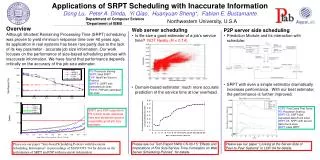
New Applications: Web server scheduling (TR NWU-CS-04-33) • Is file size a good estimator of a job’s service time (processing time)? Not Really (R 0.14) File Size Service time (wall clock time)
New Applications: Web server scheduling • Domain-based estimator: much more accurate prediction of the service timeat low overhead
New Applications: P2P server side scheduling (LCR ’04) • “Server side” of current file sharing P2P applications superficially similar to web server • Both send back files upon requests. • However, P2P application can’t even know the file size accurately a priori • Partial downloads • Our ongoing work shows that SRPT-E performs well using our time-series based job size estimators.
New Applications: Network backup system scheduling • Incremental backup copies only the files that have been created or modified since a previous backup • With Incremental backup, the actual job sizes is difficult to know until the backup finishes • We believe that SRPT-E or FSP-E can be applied with time series based job size predictors
Summary • Performance of size-based scheduling policies depends on correlation between size estimates and actual sizes • Fairness, mean response time, etc. • Estimator must preserve ordering of job sizes for high performance • Performance degrades as correlation degrades • Effective new estimators for Web and P2P
For MoreInformation • Prescience Laboratory • http://plab.cs.northwestern.edu For more details on the applications, please also see our short paper “Applications of SRPT Scheduling with Inaccurate Scheduling Information” in digital proceedings of MASCOTS ‘04 and a poster this evening.