Understanding Technological Progress and Its Impact on Production Function Dynamics
This overview explores the intricate relationship between technological progress and production functions, specifically focusing on the concepts of effective labor and capital per effective worker. Assuming constant returns to scale, the analysis covers key variables like investment, population growth rates, and technological advancement rates. It highlights the required investment to maintain capital levels amidst labor force growth and examines output growth trends in developed economies post-1950, emphasizing the determinants of sustained economic growth and the slowdown observed in recent decades.

Understanding Technological Progress and Its Impact on Production Function Dynamics
E N D
Presentation Transcript
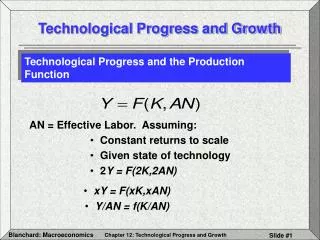
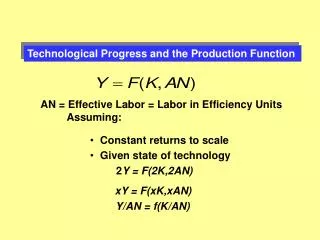
xY = F(xK,xAN) • Y/AN = f(K/AN) Technological Progress and the Production Function AN = Effective Labor = Labor in Efficiency Units Assuming: • Constant returns to scale • Given state of technology • 2Y = F(2K,2AN)
f(K/AN) Output per effective worker, Y/AN Capital per effective worker, K/AN Technological Progress and the Production Function Decreasing returns to Kapital per Effective Worker
Production f(K/AN) Investment sf(K/AN) Investment, Capital, & Output per Effective Worker Output per effective worker, Y/AN Capital per effective worker, K/AN
Determining the needed to maintain a given Investment per effective worker to keep capital per effective worker steady Assume: • A population growth rate/yr (gN) • N grows at same rate as gN • Rate of technological progress gA Then: Growth rate of effective labor (AN) = gA + gN If: gA = 2% & gN = 1%, then AN growth = 3%
The level of investment needed to maintain : Determining the needed to maintain a given • Must offset depreciation, δK • Must outfit new workers with capital, gNK • Must give all workers additional capital to keep up, gAK Amount of Investment Needed/Effective Worker to maintain a constant K/AN =
Required investment ( + gA + gN)K/AN Production f(K/AN) * B Investment sf(K/AN) C Observe (K/AN)0: AC > AD D A (K/AN)o (K/AN)* Dynamics of Capital & Output Output per effective worker, Y/AN Capital per effective worker, K/AN
Dynamics of Capital & Output Observations about the Steady State: • Growth rate of Y = growth rate of AN = gY • gY = (gA + gN) • Outputgrowth rate [= gA + gN] independent of s • Capital growth rate gK = (gA + gN) • Capital keeps up with labor force and technology • Per worker output growth rate = gY – gN= gA
Growth: rate of 1. 2. 3. 4. 5. 6. 7. Capital per effective worker 0 Output per effective worker 0 Capital per worker gA Output per worker gA Labor gN Capital gA+gN Output gA+gN Dynamics of Capital & Output The Characteristics of Balanced Growth
f(K/AN) B ( + gA + gN)K/AN 0 A Savings = s0 s1f(K/AN) Output per effective worker, Y/AN s0f(K/AN) 0 1 1 Savings increase to s1 S1f(K/AN) Steady-state = & Steady-state = & (K/AN)0 (K/AN)1 0 1 Capital per effective worker, K/AN The Effects of the Savings Rate
Associated with s1 > s0 Associated with s1 > s0 B B Output, Y (log scale) Capital, K (log scale) B B A A slope (gN + gA) Associated with s0 slope (gA + gN) Associated with s0 A A t t Time Time The Effects of an Increase in the Savings Rate
Technological Progress and Growth The Facts of Growth Revisited A Review • Observations on growth in developed countries since 1950: • Sustained growth 1950-mid 1970s • Slowdown in growth since the mid 1970s • Convergence: countries that were further behind have been growing faster
The Facts of Growth Revisited Understanding These Trends Capital Accumulation vs. Technological Progress • Determinants of Fast Growth: • Higher rate of technological progress (gA) • Higher level of capital/effective worker (K/AN)
Inferring rate of technological progress, gA Growth of Output per Capita, gY/N Rate of Technological Progress, gA 1950-73 1973-87 Change 1950-73 1973-87 Change (1) (2) (3) (4) (5) (6) France 4.0 1.8 -2.2 4.9 2.3 -2.6 Germany 4.9 2.1 -2.8 5.6 1.9 -3.7 Japan 8.0 3.1 -4.9 6.4 1.7 -4.7 United Kingdom 2.5 1.8 -0.7 2.3 1.7 -0.6 United States 2.2 1.6 -0.6 2.6 0.6 -2.0 Average 4.3 2.1 -2.2 4.4 1.6 -2.8 gY = αgK + (1- α)(gN + gA) For Y = F(K,AN) where α = capital share of national income (1 - α) = labor share of national income Can measure Solow residual (total factor productivity) as gY not explained by capital growth and labor force growth Residual = gY – {α gK + (1 – α) gN} Then (1-α)gA = Residual … or gA = Residual/(1-α)
Technological Progress and Growth Capital Accumulation vs. Technological Progress The Findings • 1950-1973 high growth of output per capita due to technological progress • Since 1973 slowdown in growth of output per capita due to a decrease in the rate of technological progress • Convergence is the result of technological progress