Understanding Oxidation-Reduction Reactions: Fundamentals and Applications
This resource explains the fundamentals of oxidation-reduction (redox) reactions, emphasizing the transfer of electrons during these processes. It introduces the concept of spontaneous and non-spontaneous redox reactions, highlighting common examples involving sodium and chlorine. The document also outlines rules for assigning oxidation numbers, the roles of reducing and oxidizing agents, and provides information on electrochemical terminology and various types of cells, including voltaic and electrolytic cells. Understanding redox reactions is crucial for various applications in chemistry and energy production.

Understanding Oxidation-Reduction Reactions: Fundamentals and Applications
E N D
Presentation Transcript
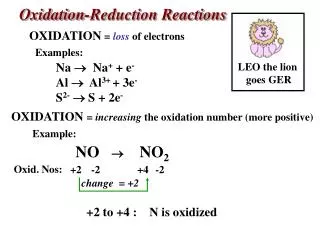
Oxidation-Reduction Reactions LEO SAYS GER
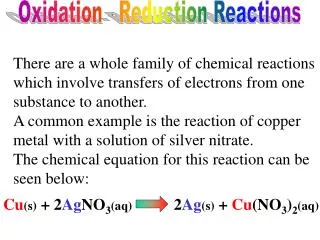
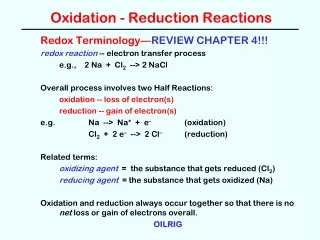
Oxidation and Reduction (Redox) • Electrons are transferred • Spontaneous redoxrxns can transfer energy • Electrons (electricity) • Heat • Non-spontaneous redoxrxns can be made to happen with electricity
Oxidation Reduction Reactions(Redox) Each sodium atom loses one electron: Each chlorine atom gains one electron:
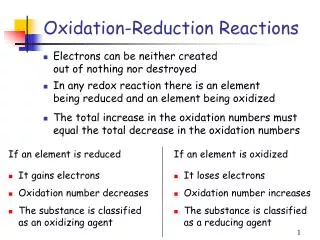
LEO says GER : Lose Electrons = Oxidation Sodium is oxidized Gain Electrons = Reduction Chlorine is reduced
Not All Reactions are Redox Reactions Reactions in which there has been no change in oxidation number are not redoxrxns. Examples:
Rules for Assigning Oxidation NumbersRules 1 & 2 • The oxidation number of any uncombined element is zero 2. The oxidation number of a monatomic ion equals its charge
Rules for Assigning Oxidation NumbersRules 3 & 4 3.The oxidation number of oxygen in compounds is -2 4. The oxidation number of hydrogen in compounds is +1
Rules for Assigning Oxidation Number Rule 5 5. The sum of the oxidation numbers in the formula of a compound is 0 2(+1) + (-2) = 0 H O (+2) + 2(-2) + 2(+1) = 0 Ca O H
Rules for Assigning Oxidation NumbersRule 6 6. The sum of the oxidation numbers in the formula of a polyatomic ion is equal to its charge X + 4(-2) = -2 S O X + 3(-2) = -1 N O X = +5 X = +6
Reducing Agents and Oxidizing Agents • The substance reduced is the oxidizingagent • The substance oxidized is the reducingagent Sodium is oxidized – it is the reducing agent Chlorine is reduced – it is the oxidizing agent
Trends in Oxidation and Reduction • Active metals: • Lose electrons easily • Are easily oxidized • Are strong reducing agents • Active nonmetals: • Gain electrons easily • Are easily reduced • Are strong oxidizing agents
Electrochemical Terminology Electrode: A conductor used to establish contact with a nonmetallic part of a circuit, such as an electrolyte Half-cell: a metal electrode in contact with a solution of its own ions Anode: The electrode where oxidation takes place Cathode: The electrode where reduction takes place
Voltaic Cells Anode: negative Cathode: positive Voltaic cells: Electrochemical cells in which a spontaneous redox reaction can be harnessed to produce an electric current.
Electrolytic Cells Anode: positive Cathode: negative Electrolytic cells: Electrochemical cell in which an electric current is used to drive a non-spontaneous process
Electrolysis of H2O 2H2O 2H2 + O2 Electrolyte is usually dilute sulfuric acid
Electroplating of Silver Cathode is the object to be plated Anode is a piece of the plating metal Solution contains ions of the plating metal
Measuring Electrode Potential 1. H2 Electrode is assigned a potential of zero volts 2. Second electrode is placed in a solution of its own ions 3. Reduction potential of second electrode is measured.